Category Archives: Christian humanism

Christian humanism as foundation for the faith and work conversation, part III


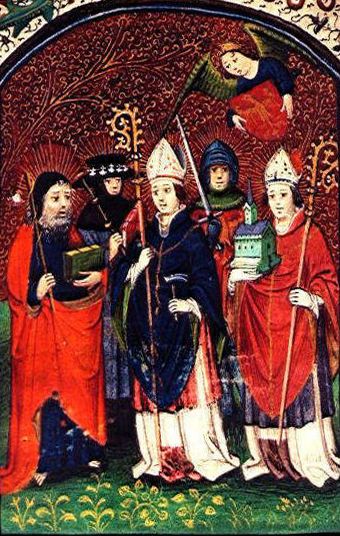
Saint James as a Pilgrim with a Purse and Staff (detail), Workshop of the Bedford Master, Paris, about 1440-50, Book of Hours (text in Latin). The J. Paul Getty Museum, Ms. Ludwig IX 6, fol. 203v

This article continues from part II.

Scholastic humanism

Skipping ahead, from the 11th through the 13th century, a new phase of Christian humanism arose – in the thought and work of “scholasticism” – a movement in Christian thought that is understood by historians to have its intellectual foundations in Augustine, its early formulation in the work of Anselm of Canterbury in the 11th century, and its pinnacle in the grand system of Thomas Aquinas in the 13th.

The medieval scholastics continued and intensified the high humanist evaluation of human reason. As historian of science Edward Grant has comprehensively shown, no line can be drawn between the Middle Ages as a supposed “age of faith” and the 17th and 18th century “age of reason,” for both ages shared “the profound conviction that their beliefs could be reasonably demonstrated” and “medieval university scholars and teachers . . . placed a heavy reliance on reason,” and in fact, “in the history of civilization, they were the first to do so self-consciously on a grand scale.” Building on over a millennium of Christian thought about the Genesis portrayal of the imago dei, passed on from patristic thinkers such as Justin Martyr and Augustine of Hippo, the scholastics argued like this:

Continue reading

Worth reading: Christian humanist/medieval “retrievalist” Remi Brague


Soon I intend to post part II of the “Christian humanism as foundation for the faith and work conversation” article. For now, though, I want to share a scholar who just came onto my radar:

Friend Andrew Hansen at Anselm House Christian Study Center at the University of Minnesota passed along to me the name of a scholar I can’t wait to read. For a peek into French historian of philosophy Remi Brague’s work, see this review of Brague’s 2019 book Curing Mad Truths: Medieval Wisdom for the Modern Age (so widely read and well-received that it was reissued in 2022). [Love the subtitle – it has a familiar ring!] A quick excerpt:

“G. K. Chesterton was right: the modern thinkers were thieves and counterfeiters. They lifted truths embedded in medieval culture and articulated by pre-modern thinkers, reworked them, and passed them off as new, emancipatory, and empowering. The stolen ideas were pressed into the service of a vast new enterprise, “the modern project.” Proponents of the project promised that henceforth man could make his own way in the world, without any higher assistance or guidance whatsoever. Brague calls this “exclusive humanism,” because it excludes any higher Instance—cosmos or Creator or binding tradition—in the understanding and fulfillment of the human.”

“. . . It certainly does not mean repudiating the modern world in all its aspects and works. That world has “precious gains” that should be “safeguarded.” However, we must understand the core tenets of the medieval worldview (starting with creation and providence) that gave rise to these positive truths. It means noting what is missing or garbled in the extracted modern versions. It means bringing the two together in a new synthesis, one that neither party could effect in their day. Rather than a reactionary appeal, therefore, “medieval wisdom for the modern age” is a contemporary call for an unprecedented synthesis.”

Having received Andrew’s tip and read the above review, I immediately asked friend and prolific scholar of Christian humanism Jens Zimmermann at Regent College what he thought of Brague. Had he read him? Most certainly! And in fact he compared Brague favorably to one of the most influential philosophers in my own intellectual pedigree, Charles Taylor. Well, that got my attention! I’m eagerly awaiting copies of several of his books and look forward to delving into them.