Tag Archives: medicine

Did early Christians reject secular medicine? Glimpses from Darrel Amundson


Cover of

From a fascinating book by Darrel W. Amundsen—Medicine, Society, and Faith in the Ancient and Medieval Worlds (Baltimore, MD: Johns Hopkins University Press, 1996)—come the following observations on early Christian attitudes toward medicine and physicians. These excerpts come from chapter 5, “Medicine and Faith in Early Christianity” (sentences not in quotation marks are comments from me). See here for further insights from Amundsen, on what medievals thought caused illness. And see here for some of his observations on the spiritual usefulness of illness and the meaning of plague.

“While among pagans [128] and Christians the same range of attitudes toward medicine and healing existed, there was one essential difference between pagans and at least those Christians who had actively embraced the gospel. . . . This pervasive difference between pagans and Christians resulted from the highly personal relationship existing between the individual Christian and an omnipotent God who was typically viewed as a having a direct concern with and involvement in the life of the believer. Continue reading

Healing hospitality in the early church


This will be the last post from Guenter B.
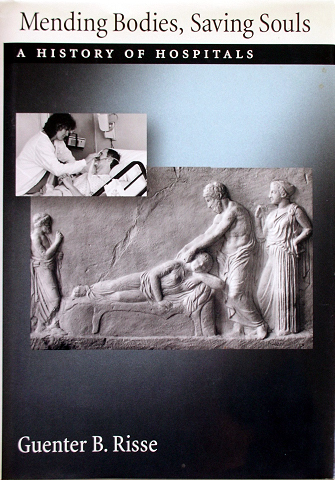
Risse’s Mending Bodies, Saving Souls: A History of Hospitals (Oxford University Press, 1999). In these excerpts from chapter 2, “Christian Hospitality,” Risse sketches the events and ideas that shaped the church’s commitments to providing healing spaces in its earliest centuries.

[Page numbers listed at the beginning of each paragraph. To see other posts from Risse’s book, put his name in the search box near the top of the right column of this blog.]

69           “Late in the year 499, the ‘Blessed City’ of Edessa in southeastern Anatolia, with an estimated population of about 10,000, experienced a great crisis. Frequent wars in the surrounding countryside four years earlier had already destroyed entire villages and ruined the fields. This situation was blamed for an epidemic of boils and swellings during which many inhabitants apparently went blind. By the fall of the year 499, agricultural failures in the surrounding rural areas multiplied due to swarms of locusts devouring the remaining crops. Continue reading

Jerusalem’s Hospital of St. John: A model medieval hospital


Guenter Risse has provided, in his Mending Bodies, Saving Souls, a fascinating account of the Hospital of St. John in Jerusalem during the crusader years.

The Hospital reflected and elaborated on the values found in the earlier monastic history of Christian hospitals. Here are some glimpses, prefaced by a brief timeline of Jerusalem’s history: Continue reading

Women practicing medicine in the early church


Image of Kate Campbell Hurd-Mead (1867 - 1941)...

Kate Campbell Hurd-Mead, pioneering gynecologist

Women led in early Christendom in the area of medicine. Though the knowledge and practices of that field during those days were primitive, even laughable by today’s standards, late ancient and early medieval medical practitioners of both sexes did do significant good in nursing and basic care. Their work helped set the stage for the development of hospitals and religiously based medical ministries that dominated the field throughout the Middle Ages.

What follows are excerpts from a book I discovered while working on the profile of Christian medical ministry for the Bethel Seminary course (and I hope future book) Resources for Radical Living. The book is Kate Campbell Hurd-Mead, M.D.’s A History of Women in Medicine (Haddam, Conn..: Haddam Press, 1938). I have included only a small sampling of the fascinating accounts in the book:

[For more on early Christian medical ministry, see here and here.] Continue reading

How did hospitals begin to change from monastic to “secular”?


Reading Guenter Risse’s account, in Mending Bodies, Saving Souls, of how hospitals were pioneered and operated for many centuries by monks, I began to wonder–how and why did this situation change? How did we get from monastic hospitals to the huge, shiny, bureaucratic and largely secular institutions that loom on today’s medical landscape? Here is the beginning (but only the beginning) of the answer to my question:

“[In the 11th century,] Benedictine monasteries throughout Europe ceased to play their hitherto prominent roles in the provision of social welfare and medical care. For almost 1,000 years, almshouses and hospitals had been organized and run in accordance with highly successful monastic models of prayer and work. Now, in the face of rapid population growth and urbanization, these establishments became inadequate purveyors of traditional charitable assistance. An increasingly urban economy based on commerce that demanded markets, contracts, and currency loans rapidly became the instrument and measure of work. Continue reading

What did medieval hospitals look like?


Continuing my reading of Guenter Risse’s Mending Bodies, Saving Souls, I encounter the following vivid description of the look, feel, administration, and theological underpinnings of those first medieval hospitals. This was not some blip in the history of medicine, but rather the way hospitals were run for many centuries from their medieval inception:

“Until the time of Purchard’s rule at St. Gall [monastery in Switzerland: Purchard was abbot from 958 to 971], hospitals in the West had been mostly small shelters established mainly for the homeless poor and travelers, including pilgrims. Some were located in cities, attached to a bishop’s palace; others operated near major roads, on mountain passes, or in monasteries alongside infirmaries restricted for sick monks. Hospitals comprised a lodging hall with 12 – 15 beds, an attached kitchen, and a chapel. Dormitories featured suspended mattresses filled with straw, pillows, bed sheets, and blankets. The large beds held two or three inmates.” (106) Continue reading

Medieval monasteries in the history of hospitals


It’s often the “just-right source” that opens up a topic for me, and as I teach it, for my students. In the Resources for Radical Living course, I will be profiling the history of Christian practices of medical healing (that is, not including “faith healing”). An excellent source on this topic just came to me via the wonderful almighty inter-library loan system (thank you Mark Nygaard in the Bethel Seminary library), and I’d like to share a bit of it with y’all. [For more of the story beyond what follows, see here and here.

Guenter B. Risse of the Department of the History of Health Sciences, UC San Francisco, provides fascinating insights into the many stages of medical practice within Christian communities from the earliest years of the church onward in his compendious book Mending Bodies, Saving Souls: A History of Hospitals (Oxford University Press, 1999).

To take just one example: I have seen it said in a number of places that the hospital was a medieval Christian invention. What follows are some excerpts from Risse on health care within medieval monasteries, from chapter 2: “Christian hospitality.” “Invention” is likely too strong a word to use of medieval developments in care of the sick–the Cappadocian father Basil the Great (330 – 379) was setting up something like ancient hospitals in Caesarea to address famine and disease in that city, and there were earlier pagan models that bore some resemblance to what later became hospitals. However, we can see from early on in Benedictine monasteries many of the rudiments of modern hospitals:

“From the start, providing hospitality and healing the sick became key responsibilities of European monasteries, reflective of both the inward and worldly missions they had assumed. As in the East, early Christian welfare in Europe targeted voluntary and structural paupers—there were few distinctions between them—as well as pilgrims. Continue reading

Evangelicals and psychiatric services


The following is part of a talk I was invited to give to a group of psychiatric residents (doctors-in-training) here in the Twin Cities a few years ago. The talk was on “the evangelical tradition,” and was intended to give these medical practitioners a sense of the beliefs of evangelicals, possible impediments to serving this constituency, and ideas of how to serve them better.

I have already posted other portions of this talk here under the titles “Basic, basic Christianity” and “Evangelicalism–a basic summary,” part I, part II, and part III. What follows is the final portion of the talk, which outlines issues that may face a professional providing evangelicals with psychiatric services, and ideas on how to serve (some) evangelicals better:

Now I’d like to turn the corner and address more directly some of the challenges that may come up in serving evangelical Christians from within the field of mental health care.

The insights that follow mostly come from my Bethel colleague Steven J. Sandage, Associate Professor of Marriage and Family Studies, Bethel St. Paul. Steve has served as clinician, psychologist, and chaplain in a variety of settings (community mental health, correctional, university) and currently engages in part-time clinical practice. He taught at Virginia Commonwealth University and the Medical College of Virginia as an adjunct faculty prior to coming to Bethel.

As Steve has related it to me, some evangelicals have a tendency to over-spiritualize—they frame problems as spiritual, not being able to think in an integrative way about the interactions of their minds, emotions, spirits, and the material world. They may refuse medication, for example, because they think this would show a lack of faith in spiritual truth or spiritual reality. Continue reading

Not a mercy but a sin: Christian tradition vs. euthanasia


Though the following e-newsletter from my days at Christianity Today International opens with an out-of-date reference to the late Terry Schiavo, the topic is as pressing as ever. What should we as Christians think about euthanasia, or “mercy killing”?

Some time after this piece was posted on CTI’s website, it was reprinted as the lead essay in Euthanasia: Opposing Viewpoints, ed. Carrie L. Snyder (Thomson Gale/Greenhaven Press, 2006). The piece was retitled “Christianity Condemns Voluntary Euthanasia,” and it was followed by an essay from the opposite viewpoint: “Christianity Should Condone Voluntary Euthanasia.” The author? Liberal Episcopalian John Shelby Spong.

(Some links in the following are likely out-of-date.)

Not a Mercy but a Sin
The modern push for euthanasia is a push against a two-millenniums-old Christian tradition.
Chris Armstrong

The case of Terri Schiavo, a severely brain-damaged Florida woman who has been on life support for over a decade, has reopened debate by secular and church authorities alike on questions surrounding euthanasia or “mercy killing.”

The matter is admittedly not simple. But the Christian church has, at least until recent decades, spoken on it with a fairly unified voice.

Continue reading

Religion & science post #3: Christian fathers of the scientific revolution, and more


Third and final post on religion & science, at least for today. The following is the candy bowl of factoids I compiled for the front of Christian History Issue #76: The Christian Face of the Scientific Revolution. Included is a list of “fathers of modern science,” all of whom explored science out of Christian motives:

The Christian Face of the Scientific Revolution: Did You Know?
Interesting and unusual facts about Christians in the scientific revolution.

Astronomer by Night, Canon by Day

When Nicolaus Copernicus wasn’t redrawing the celestial map, he held down a day job as a Catholic canon (ecclesiastical administrator). As the Reformation grew rapidly and extended its influence in Poland, Copernicus and his respected friend Tiedemann Giese, later bishop of Varmia, remained open to some of the new ideas. Continue reading