Category Archives: Work with purpose

Millions of Western Christians experience a painful bifurcation between their faith and their work. How can Christians see the divine purpose in their “secular” labors? And where can God’s purposes be found in the economic sphere?

Is work irredeemably secular? – part V (final)


Photo by José Martín Ramírez Carrasco on Unsplash

Continued from part IV

Wesley and Sheldon help us answer important questions about working in the modern world, addressing today’s tangle of injustices, our oppressive systems and structures, and the broken people all around us who need healing. But one more question remains:

4. Where is God in the work itself—the everlasting grind of creating goods and services for others?  Can our work—even in workplaces whose missions may seem so far from Godly—actually connect us with God and his mission on earth?

Again, Martin Luther gets us partway to an answer—teaching us that in our work, we become the hands of God for his provision to our neighbor, so that every kind of work we do in the marketplace, the home, and the civic sphere is truly a vocation from God.

However, in reaction to strains of works-righteousness in late medieval thought, Luther felt he had to insist that no kind of earthly work has any direct relation to our spiritual lives—our preparation for eternity, our progress in sanctification and salvation.

Intensified by Luther’s contemporary Ulrich Zwingli, this nervousness about the “outer,” physical life as spiritually irrelevant (at best) or dangerous (at worst) has continued to weave its way through Protestant piety ever since. Protestants have not much expected our “active lives” to connect us to God. We seem to have lost Gregory’s teaching that in our most mundane work, if we have but ears to hear and eyes to see, God does meet us and minister not only through but also to us.

If only we had a modern teacher who had adopted and absorbed the sacramentalism of Gregory and his era! I’ll suggest that in fact, we do have at least one such teacher:

Continue reading


Is work irredeemably secular? – part IV


Continued from part III

The Methodist story gives us a vision for responsible work and broad social action, but we may still wonder today—and this is our third question—(3) how we can work faithfully while also while actively pushing back against those parts of our organizations and sectors that are unjust, or immoral—that is, that harm rather than hurt people? Where are the Christian resources that can help us act redemptively within unredeemed systems?

One Christian leader who armed others for such redemptive action was the late-Victorian American Congregational pastor Charles Sheldon.

It’s a Sunday morning near the end of the 1800s, in the comfortable upper-middle-class “First Church” in the town of Raymond, somewhere in the Midwest. Halfway through the service, a tired, sick homeless man walks into the church, up the aisle to the front, and begins to speak. He wonders aloud why there is so much trouble and misery in the cities when their well-off Christians sing so much about consecrating themselves entirely to God. “It seems to me,” he says, “there’s an awful lot of trouble in the world that somehow wouldn’t exist if all the people who sing such songs went and lived them out. I suppose I don’t understand.” Then he asks, in that now-familiar phrase: “But what would Jesus do?’”

Continue reading

Is work irredeemably secular? – part III


2012 London Olympics final rehearsal, “Pandemonium” section, by Matt Lancashire (Wikipedia, Creative Commons license)

Part II of this series ended with this statement:

So our first question—does time dedicated to working in the secular world endanger our souls?—is answered by Gregory like this: the active life of service may serve as handmaiden to the contemplative life – and the contemplative to the active, in return.

Sadly, medievals did not always remember this insight, tending to return to the old elevation of the monastic life above the ordinary life. This was one reason Martin Luther found himself, in the 16th century, needing to recover the God-givenness of bakers baking and tailors sewing and fathers changing their infants’ diapers.

On Luther, more later. But now another challenging question arises in our complex, post-Christian workplaces full of real, fallen people:

2. Does practicing the virtues demanded by the working life (such as industriousness, self-control, service to others, obedience to rules and leaders) reduce us to drones or pawns in exploitive structures of modern work? Or, Does becoming a good Christian worker mean sacrificing social conscience for placid obedience—prophetic witness for financial security?

To help us answer this, we turn to our second past leader, England’s 18th-century evangelical pioneer, John Wesley.

Anyone remember the opening ceremony of the 2012 London Olympics? As the spectacle started, before millions of worldwide viewers, England’s pastoral island paradise rose slowly into view from below ground, to the wafting strains of British composer Edward Elgar.

But then – suddenly – the paradise was shattered. 

Continue reading

Is work irredeemably secular? – part II


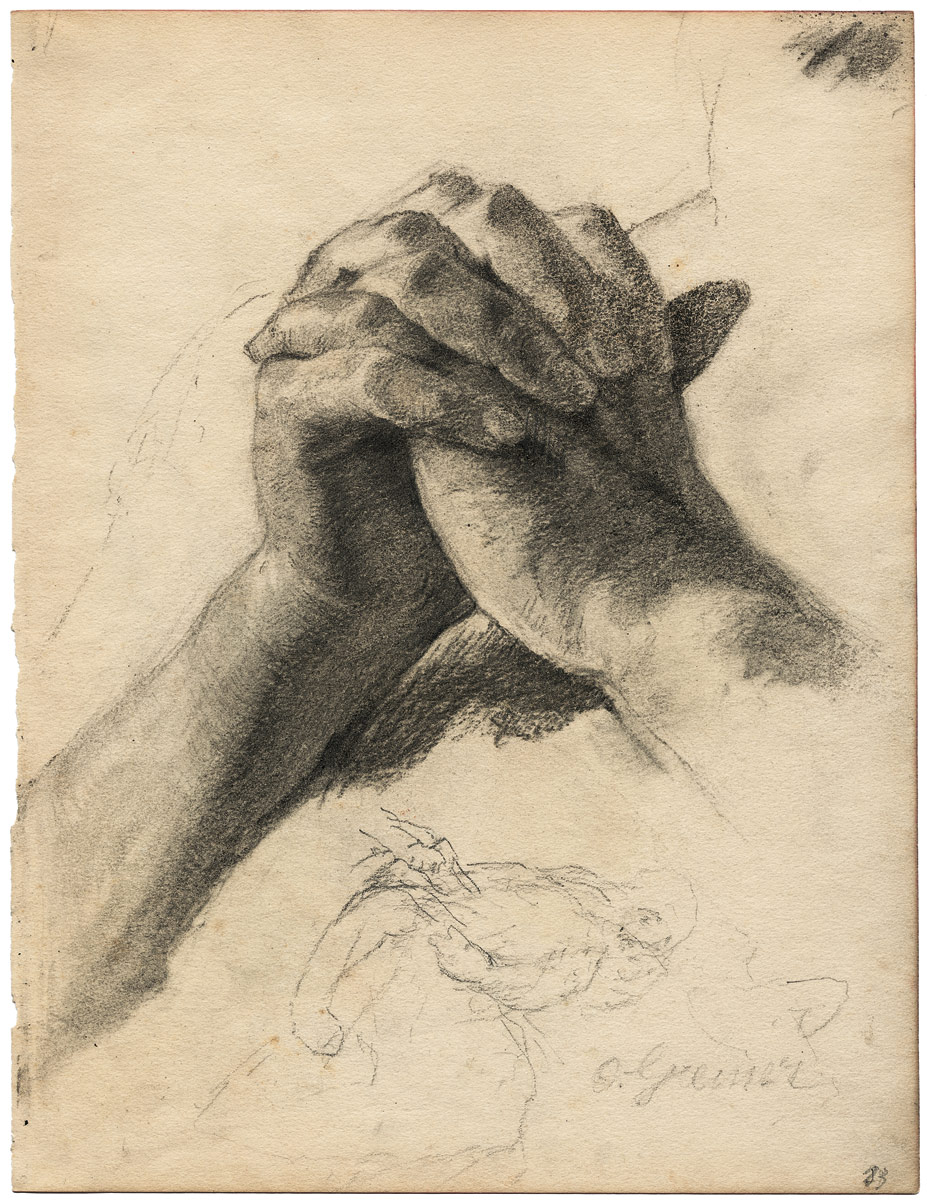
Otto Greiner, “Betende Hande”

Continued from part I

Let’s jump right in. I’m going to frame each of these four issues in the form of a question that may stand between us and a sense of Christian vocation in our work.

Here’s the first question that may be nagging us as we seek a sense of vocation in our work:

  1. Does time dedicated to working in the secular world endanger our souls? Is there an inherent tension or contradiction between the “worldliness” of work and the “spirituality” of faith?

A century or two before the opening of the Middle Ages, the theologian whose influence would become definitive for the next thousand years, Augustine of Hippo, distinguished two spheres of human endeavor: the “active life”—our work in the world—and the “contemplative life”—our private worship and prayer. The active life could be good, but the contemplative life, such as that enjoyed by monks and nuns, was much better—and indeed safer for our souls.

Augustine’s bifurcated view of work has persisted in some circles right up to this day – but it was quickly challenged by the man some consider the spiritual father of the medieval church, as Augustine was its theological father.

Continue reading

Is work irredeemably secular? – part I


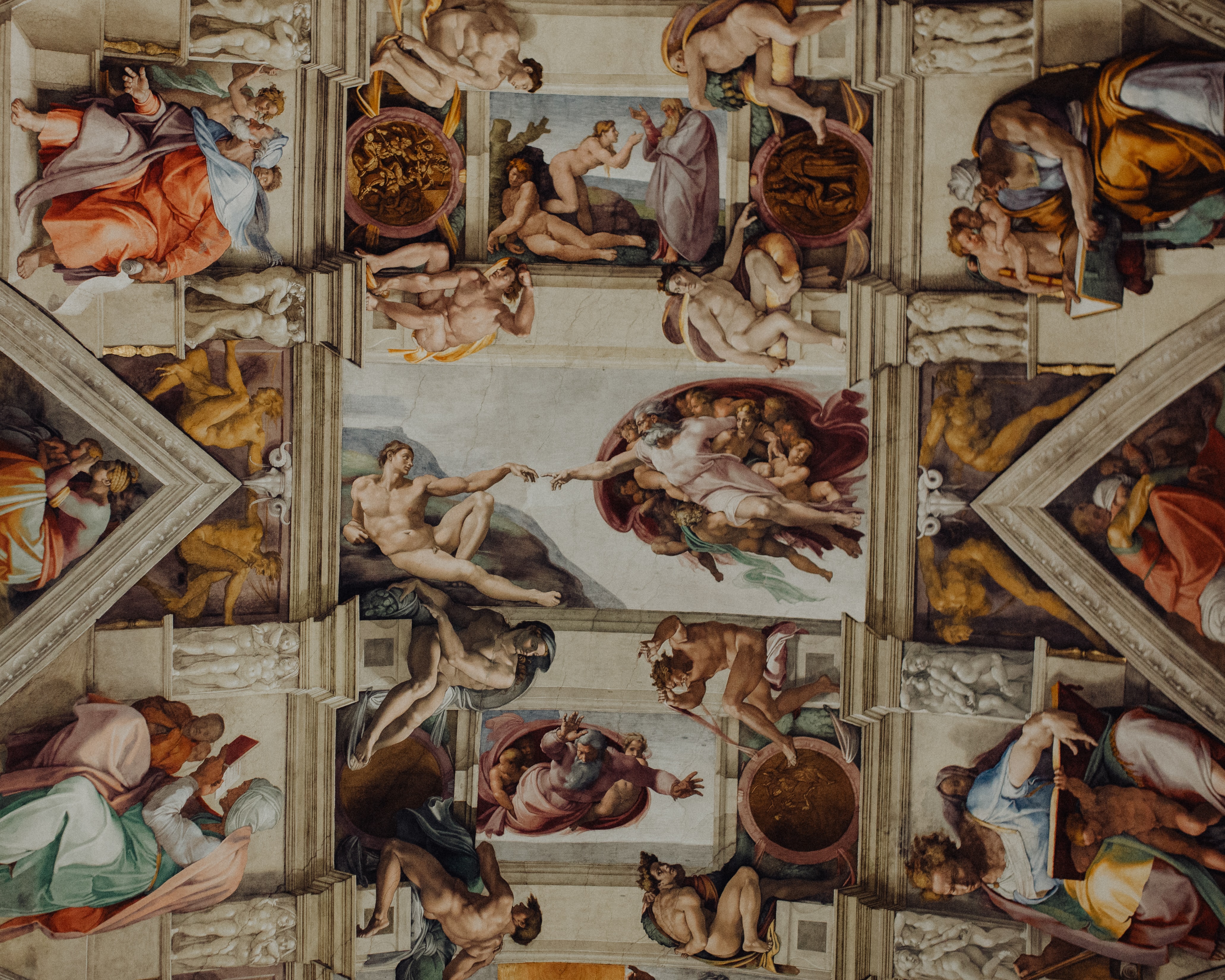
Cathedral of St Stephen, Brisbane; wikimedia (creative commons)

A couple of years back, in the depths of the COVID pandemic, I was invited by Sioux Falls Seminary to address an international group of their students via Zoom on a topic related to faith and work. Reflecting on the assignment, and aware that I would be addressing workplace Christians studying for ministry in one of the most innovative seminaries in the world (which has now spread globally and renamed itself Kairos University), I decided to address the “sacred-secular divide” that many experience acutely in their working lives. The resulting talk draws on four historical figures who addressed this divide in various ways. Here it is, in five parts:

This past January, I was co-teaching a group of graduate students at Regent College, in Vancouver, BC, with that wise and humane thinker on faith and vocation, my friend Steve Garber. Steve had asked me to join with him in creating and teaching a course for Regent called “Models of Public Engagement.” My contribution was to provide readings, mini-lectures, and discussion prompts from a wide variety of historical people of Christian faith. By the class’s second day together, in our Vancouver intensive week during which it would snow, rain, and blow gusts of freezing wind every day, it had already become a class joke that all of Dr. Armstrong’s best friends are dead.

This is actually not far off the mark. You can find my blog-site, for example, at “gratefultothedead.com.” (This, by the way, has confused more than a few Grateful Dead fans, who have wandered onto the blog expecting to find me writing about Jerry Garcia.)

But I can’t help myself. I love introducing people to my friends. As a wise priest once said to me, the teaching gifts of our past leaders have a very long shelf life. Yes, and I’d add, their lives as well as their teachings can also still speak to us today. So this afternoon as we dive into a few questions about how to find Christian vocation in a working world where Christ is so rarely named, I’ll be sharing with you from the thought and lives of four of my best dead friends. These are Gregory the Great, John Wesley, Charles Sheldon, and C. S. Lewis.

Continue reading

Christian foundations of science and technology innovation, part I


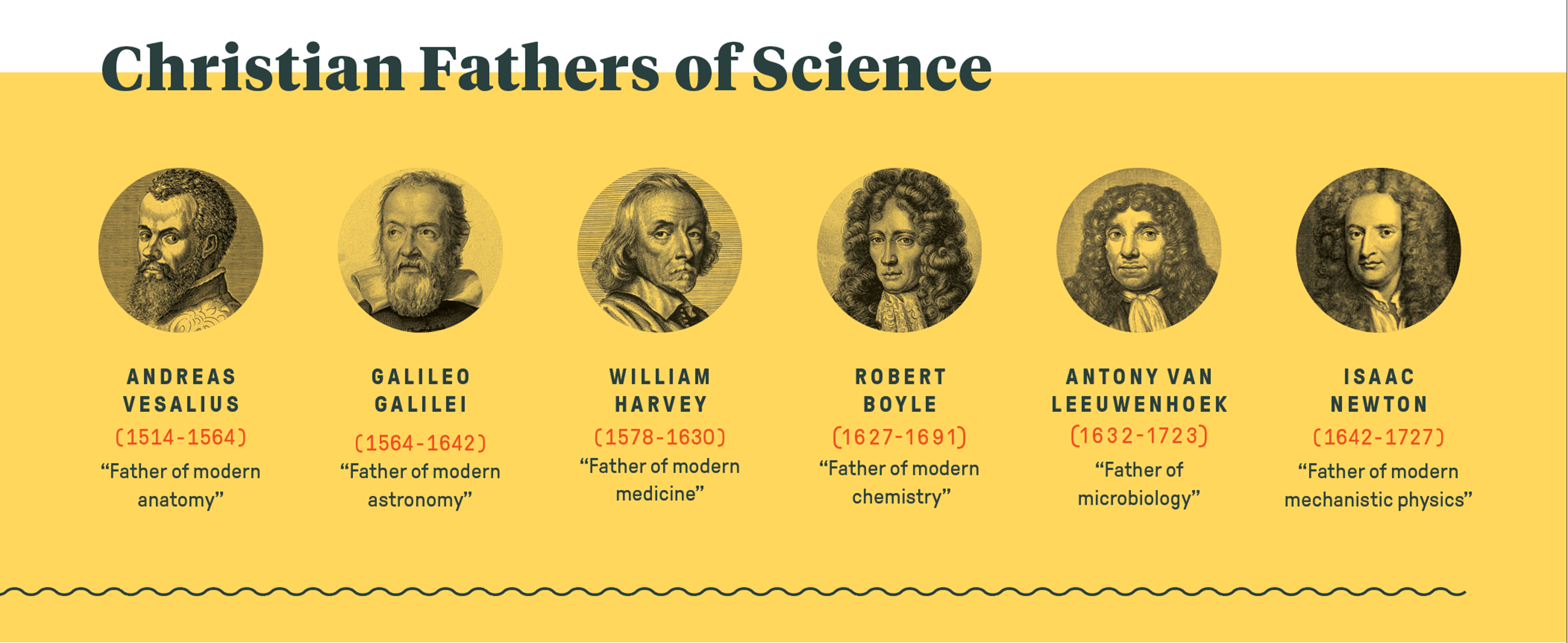
Illustration from C Armstrong, “The Pursuit of Science for God and Neighbor,” Common Good magazine issue #3, pp. 48-53

For many years I’ve attended – and sometimes spoken at – the Acton Institute’s annual four-day June meeting, “Acton University.” The 2022 meeting will happen June 20-23 both in-person in Grand Rapids and online. I’ll be giving a talk there titled “Christian foundations of science & technology innovation: A story in ten facts.” Here it is:

I’d like to start our reflection together with a question about finding Christian vocation in this tremendously important sector of modern work: science and technology.

Christians today are often told that we must bridge the so-called “sacred-secular divide” by finding divine purpose and mission in our daily work. And that sounds good in theory. It certainly has good support in both Scripture and tradition—from the Apostle Paul to Gregory the Great to Martin Luther and beyond. But where it often runs aground is in our actual experience.

Because, truthfully, our modern work contexts, and even the nature of the work we do in those contexts, seems to many of us—for many reasons—about as secular as can be.

So here’s the vocation question: How can we discover Christian vocation in fields of work that Luther could not have even imagined—let alone the Apostle Paul? In particular, how can modern people of faith experience work in the scientific laboratory or the high-tech firm as Christian mission?

Continue reading

Our earthly jobs, in light of the doctrines of creation and incarnation, pt. III


Photo by Calvin Craig on Unsplash

. . . continued from part II

The theological term for this vibrant medieval understanding of the material world, as Lewis well knew, is sacramentalism. This is a linked set of beliefs, first, that the outward and visible can convey the inward and spiritual; second, that all creation is in some sense a reflection of the creator; and third, that God is present in and through every square inch of his world. While these beliefs are linked with the more limited, liturgical sense of the word “sacrament,” they amount to an understanding of the whole material world.

The world-sacramentalism of medieval Christians was rooted in a lively engagement with the doctrine of Creation — through an even livelier engagement with the doctrine of the incarnation. The incarnation was the central preoccupation of medieval Christians. Art, theology, church life, and private devotion all focused on the incarnation. The Gospel accounts of Jesus’ bodily life and death became the medieval “canon within the canon”; the puzzle of why he had to come and die was the great theological obsession.

And in the midst of it all came the insight that, as Christ raised humanity by taking on humanity, he also in some mysterious sense, by taking on created form in his own creation, also raised up the whole world toward its new-creation destiny — such that even the rocks cry out and creation groans as it awaits that fulfilment.

In light of that cosmic redemption, and quite contrary to modern stereotypes of barbarism and otherworldliness, medieval Christians affirmed the material and social dimensions of our created human lives (our eating, drinking, working, marrying, getting sick, being healed, and eventually dying) as transcendentally important.

Continue reading

Our earthly jobs, in light of the doctrines of creation and incarnation, pt. II


Photo by Greg Rakozy on Unsplash

. . . continued from part I

Ironically, this detachment sometimes looks like worldliness or materialism: the typical modern Western mode of effectively living for material pleasures and material accumulation. Though Christians are unlikely to profess that wry modern creed, “He who dies with the most toys wins,” we are quite capable of sacrificing a great deal to the idols of career success, in order to ensure that our families have all the comforts of middle-class life, all the latest iDevices, regular vacations, and good schools and future good salaries for our kids. And these habits, too, separate the material world of jobs and careers from the spiritual world of the church. Because, as Saint Augustine taught, when we treat material goods as ends in themselves, we decouple or disconnect them from their true value and meaning in God.

A generation after Augustine, believers of the Middle Ages, unlike our contemporary Western moment, did indeed find ways to keep the spiritual and the material together. And at least one very prominent modern Christian thinker followed that age’s integrative lead. So let’s enter that age through that modern figure.

Born in 1898 in Belfast, the son of a lawyer and a cultured, linguistically gifted mother who died when he was nine, this man read voraciously and omnivorously from his earliest years. By the age of eight, he was writing stories about “dressed animals” with his brother. In his teen years, learning classics under an Irish schoolmaster, he learned to appreciate the quest for truth not as an idle intellectual exercise, but rather as a search for the truth about what is real and true in the world — and for the wisdom necessary to live the good life. And that quest led him first to a lifelong concern for moral philosophy, and then, eventually, to a vocation as a professor of medieval literature.

Continue reading

Our earthly jobs, in light of the doctrines of creation and incarnation, pt. I


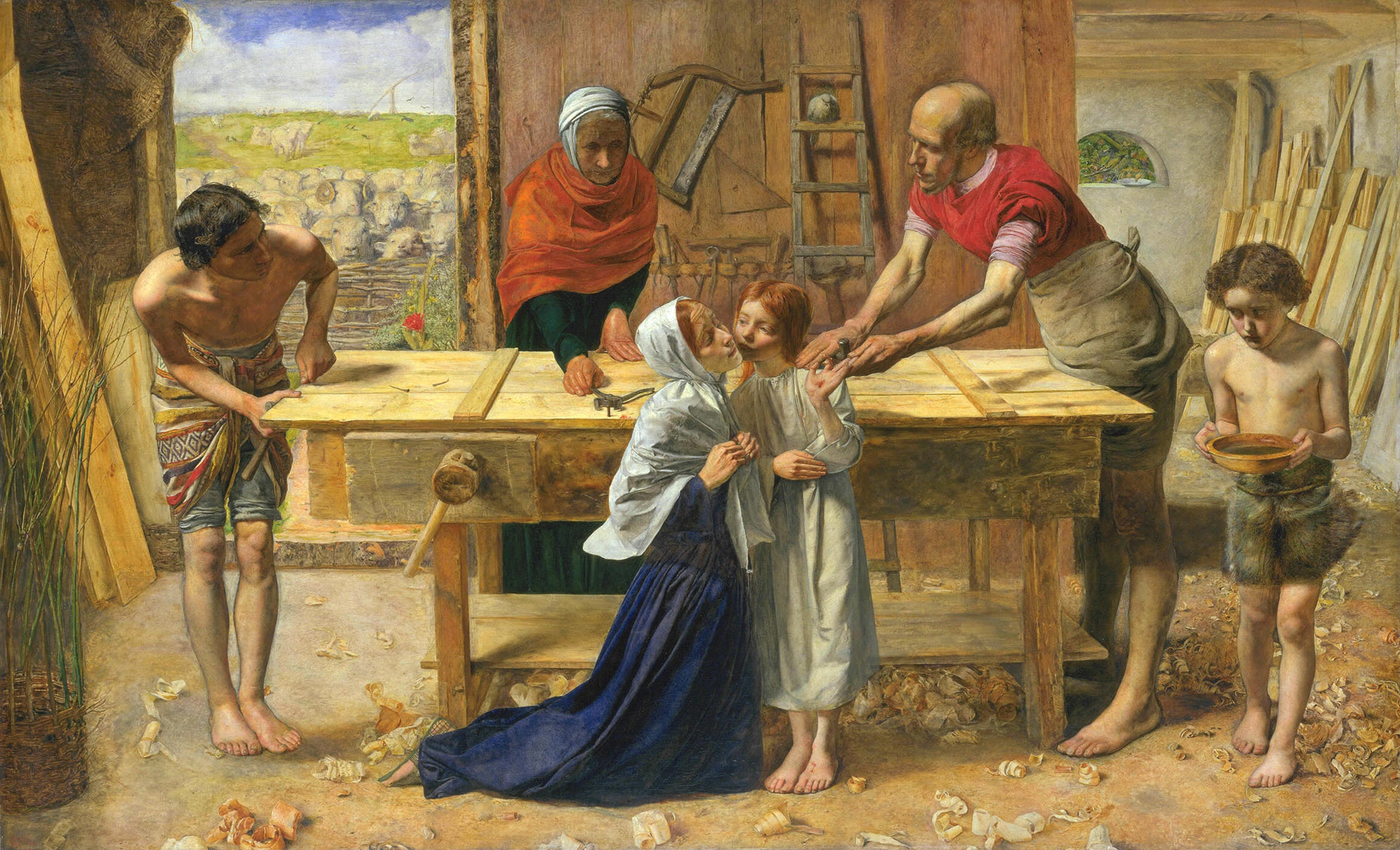
John Everett Millais – “Christ in the House of His Parents (`The Carpenter’s Shop’)”; Wikimedia Commons

I commend to you Common Good magazine. There is nothing else like it out there. And yes, though there is an online version, it contains only a modest part of what appears in the (beautiful and award-winning) print version. Seriously, you should subscribe.

In the current issue, #08, I have an article titled “The Work of Genesis: How the doctrines of creation and incarnation shine light on our earthly vocations.” Since my pieces tend not to make it into the online version (not sexy enough, I guess??), I’ll share this as a prod to subscribe:

The Work of Genesis
How the doctrines of creation and incarnation shine light on our earthly vocations

Though many of us seem to have forgotten it in our post-Christian age, “vocation” is a Christian word. And by “vocation,” the historic church — especially the Protestant tradition — has meant something like this: Meaningful work that fulfils both the Genesis mandate to cultivate and keep the earth and the great commandment to love God and love and serve our neighbors. Taking this definition, vocation finds its roots in the doctrines of creation and incarnation.

Continue reading

On how, and why, whole sectors of modern work were birthed from the heart and mind of the Christian church


Been very busy over the past few years, and a bad blogger – not posting much at all.

Among other pieces I’ve posted elsewhere but forgotten to link here at the Grateful To the Dead blog is this one, featured at The Public Discourse blog – run by the Witherspoon Institute at Princeton. The piece is a fairly brief meditation on what the Incarnation has meant in Western culture. It contains some ideas that I first published in the Medieval Wisdom book, and that I’m looking forward to extending in my next book. That book will most likely explore how entire sectors of human work that foster and support the material and social dimensions of human flourishing emerged ex corde ecclesia – from the heart of the church (and informed by the mind of the church!):

Christianity is so much more solid, and real, and human, than the “spiritual, but not religious” imitations of today. Christian faith touches every aspect of our lives—material, social, cultural. It does so because our God was born as a human baby in a stable and nurtured by a teenaged girl named Mary.

. . .

Out of a desire to imitate Christ’s compassion for those suffering from bodily illness, they poured the work of their hearts into a new institution called the hospital, succored (especially) the poor sick, and so birthed not only modern medicine but also our whole non-profit sector.

Out of fidelity to Christ’s command to “love God with their minds,” they poured the work of their minds into a new institution called the university, and so laid the foundation for the scientific revolution.

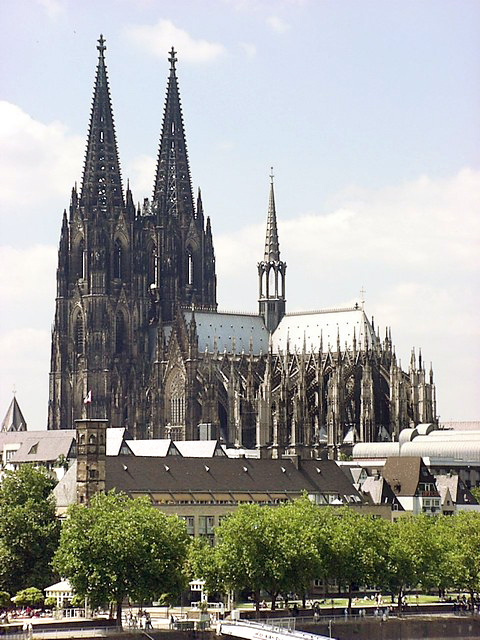
And out of aching devotion to the beauty of God’s holiness, imaged forth in Christ, they poured their imaginations and craft and labor into the glorious, soaring beauty of the Gothic cathedrals, and so nurtured and fostered artists in all media from then to now.

Healthcare. Education. Culture. To us, who labor in every kind and corner of modern human work, medieval incarnational faith speaks a “word in season.” It tells us:

Our bodies matter.

Our minds matter.

Our relationships matter.

Our work matters.