Tag Archives: early church

Ancient and medieval historical theology: Ur doin it wrong?


The subhead above should have read: “A group dedicated to doing it right.” But then I couldn’t have used this lolcat picture. And I have a weakness for lolcats.

Once in a while a bright seminary student will come to me and tell me that they want to “go on” and study historical theology, in the service of the church. What theology doctoral program should they enter?

I think of Duke and UVA, and then I’m flummoxed. Now, I know there are other good programs out there. I’m not the best-connected academic. So I suggest that the student email their question to one of the prominent senior historical theologians–UVA’s Robert Wilken is one–who are in fact pursuing their field in the explicit service of the church (may Jaroslav Pelikan rest in peace).

But it has seemed to me that the field has never quite recovered from the mid-twentieth-century assimilation of theology to the “religious studies departments” of the major universities, nor from the academy’s quite proper dismissiveness of the squabbling “my dogma is better than your dogma” confessionalism that marked the field in the decades leading up to that assimilation. Certainly, as theology still languishes far from her erstwhile status as “queen of the sciences,” historical theology as the queen’s handmaiden has also fallen on hard times.

Now I discover that a group of historical theologians at Boston College have, for the past few years, been dedicating themselves to leading their field of historical theology back to the pursuit of (this will shock you) the history of theology–instead of defense of dogma, study of philosophy, or other things only tangentially related to the health of the church. Continue reading

The Spirit of Early Christian Thought–Robert Wilken


Cover of "The Spirit of Early Christian T...

Run out and get it, & read it now!

Bryan Bademan over at the University of Minnesota‘s MacLaurin Institute has begun blogging on one of my favorite books, Robert Louis Wilken’s The Spirit of Early Christian Thought:

In his book The Spirit of Early Christian Thought: Seeking the Face of God (Yale UP, 2003), Robert Louis Wilken explains that “Christianity is more than a set of devotional practices and a moral code: it is also a way of thinking about God, about human beings, about the world and history.” Indeed, “for Christians, thinking is part of believing” (xiii). Wilken’s important work is centered on this great theme of early Christianity—that far from the faith banishing reason and clear-eyed analysis of the world, early Christians were obsessed with such intellectual practices and bequeathed to the world a faith tradition that was inextricably bound to (and yet creative with) the best of the classical past. For Augustine, this point was axiomatic: “Not everyone who thinks believes, since many think in order not to believe; but everyone who believes thinks, thinks in believing and believes in thinking” (xiv).

Wilken’s book is helpful for Christian scholars today precisely because he’s interested in “how a Christian intellectual tradition came into being.” Continue reading

Healing hospitality in the early church


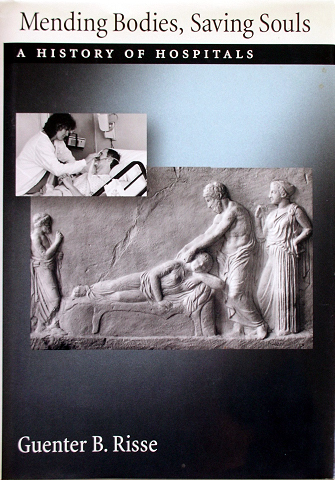
This will be the last post from Guenter B.
Risse’s Mending Bodies, Saving Souls: A History of Hospitals (Oxford University Press, 1999). In these excerpts from chapter 2, “Christian Hospitality,” Risse sketches the events and ideas that shaped the church’s commitments to providing healing spaces in its earliest centuries.

[Page numbers listed at the beginning of each paragraph. To see other posts from Risse’s book, put his name in the search box near the top of the right column of this blog.]

69           “Late in the year 499, the ‘Blessed City’ of Edessa in southeastern Anatolia, with an estimated population of about 10,000, experienced a great crisis. Frequent wars in the surrounding countryside four years earlier had already destroyed entire villages and ruined the fields. This situation was blamed for an epidemic of boils and swellings during which many inhabitants apparently went blind. By the fall of the year 499, agricultural failures in the surrounding rural areas multiplied due to swarms of locusts devouring the remaining crops. Continue reading

Women practicing medicine in the early church


Image of Kate Campbell Hurd-Mead (1867 - 1941)...

Kate Campbell Hurd-Mead, pioneering gynecologist

Women led in early Christendom in the area of medicine. Though the knowledge and practices of that field during those days were primitive, even laughable by today’s standards, late ancient and early medieval medical practitioners of both sexes did do significant good in nursing and basic care. Their work helped set the stage for the development of hospitals and religiously based medical ministries that dominated the field throughout the Middle Ages.

What follows are excerpts from a book I discovered while working on the profile of Christian medical ministry for the Bethel Seminary course (and I hope future book) Resources for Radical Living. The book is Kate Campbell Hurd-Mead, M.D.’s A History of Women in Medicine (Haddam, Conn..: Haddam Press, 1938). I have included only a small sampling of the fascinating accounts in the book:

[For more on early Christian medical ministry, see here and here.] Continue reading

Two talks: Why study early Christian history? (Everett Ferguson); The church fathers as wise exegetes (Robert Louis Wilken)


From the Wheaton Center for Early Christian Studies, check out these talks by Everett Ferguson and Robert Louis Wilken on the whys and wherefores of patristics:

3-18-2010 | Center for Early Christian Studies Spring Gathering Keynote Address by Dr. Everett Ferguson
“Why Study Early Christian History and Literature? ” (MP3)
10-30-2009 | Center for Early Christian Studies Inaugural Lecture by Dr. Robert Louis Wilken
“Going Deeper into the Bible: The Church Fathers as Interpreters” (MP3)

Signs and wonders: the charismatic power of early Christianity


Again a re-post, from the Christianity Today history blog. For a related posted on this blog, see here:

Signs and Wonders: The Charismatic Power of Early Christianity

by Chris Armstrong | January 7, 2009

When we teach about the early church, we frequently omit the story of spiritual gifts.

orant catacomb priscilla3.JPG

Cessationism is the belief that the miracles of Jesus’ lifetime and the apostolic period happened solely to attest to the authority and inspiration of the apostolic writings, and that miracles and extraordinary spiritual gifts ceased after the writing of the apostolic documents was concluded.

As writers such as ex-Dallas Seminary professor Jack Deere have argued, this is a position with no biblical foundation. But it also has a problem with the historical record. That record shows clearly that the early church was quite active in the charismatic gifts at least through 200 AD. There was a decline in the 3rd century, and then again it became active.

Sadly, many writers and teachers who are not cessationist continue to give the impression that miracles and extraordinary gifts were phenomena limited to the apostolic period. The way the early church is usually taught, we hear much about martyrdom and persecution; much about Gnostics and Arians and doctrinal disputes; much about how bishops and clergy roles evolved, and how the apostolic tradition was passed down and the canon of the New Testament evolved. Continue reading

Smorgasbord: The oldest church, some Hollywood magic, Asian-American museums, virtual catacombs, and a flaming tract


Here’s a buffet table of snips & snails from a few years ago, from the front section of Christian History & Biography issue #89: Richard Baxter & the Puritans.

On the menu are possibly the oldest church ever discovered, several Hollywood renderings of Christian historical themes, a couple of museums related to Asian Christianity in the U.S., a virtual tour of the Roman catacombs, and a flaming polemical tract by Baptist firebrand Roger Williams (who, by the way, is an ancestor of mine–I like to think I get my “free spirit” side from ol’ Rog):

Living History
Oldest church discovered, Christian history in the movies, rare book by Roger Williams
Chris Armstrong

Oldest church discovered?
In seminary, we learned that the Roman Christians didn’t start erecting public church buildings until after Constantine legalized their faith in 313 A.D. As a result, almost all evidence from the first three centuries of the church has come to us in the form of manuscripts, not architecture or furnishings. Now archaeologists have uncovered a building in the northern Israeli city of Megiddo, near the biblical site of Armageddon, that challenges the conventional wisdom. Continue reading

Three Wise Men from the East: The intrepid trio who saved the early church from idolatry


It’s tough for us to appreciate what a threat the Arian heresy was to the church in the 4th century. Basically, it had people worshiping Jesus even though they were convinced he was a fellow creature and not God–nothing short of idolatry according to the God of the Old (and New) Testament!

The Council of Nicea in 325 was supposed to slap down this mis-reading of Scripture, but for decades all it seemed to have done was stir up a hornet’s nest of controversy. For example Bishop Athanasius, the staunchest defender of orthodoxy at Nicea, was exiled by various Arian emperors no fewer than five separate times after the council was over.

Into this boiling pot of theological and spiritual confusion came three men of holy habits and clear thought: the Eastern trio now referred to as the “Cappadocian Fathers.” My friend Edwin and I engraved a cameo of each for Christian History a few years back:

Three Wise Men from the East
The Cappadocian Fathers brought the best gift of all: a powerful scriptural defense of the Trinity and Christ’s divinity against the Arian heretics.
Edwin Woodruff Tait and Chris Armstrong

Basil of Caesarea (“the Great”)
Pugnacious saint and theologian of the Spirit

Mention the “church fathers” to a Western Christian, and Basil the Great is not usually the first name to come to mind. Yet even for the Roman Catholic Church, Basil ranks with his friend Gregory of Nazianzus and John Chrysostom as one of the great propounders and defenders of the faith.

Born around 330, Basil grew up in a world where Christianity was recognized by the Roman government but divided between those who believed in the full divinity of Christ and the Arians who did not. For much of the fourth century, the Arians would enjoy the support of the emperors. The struggle between Christianity and the empire had not ended with Constantine. Continue reading

Lived theology: How and why Christian history was added to Protestant seminaries’ curricula


The stories of other Christians are vitally important to our spiritual lives. That, in fact, is why the discipline of church history was added to Protestant seminaries’ curricula. But how and when did this happen? I got to share this story with Bethel Seminary’s trustees and the readers of Christianity Today online a few years back:

When Theology Comes Alive
Living theology: that’s what the 17th-century Pietists wanted to see. And so they invented church history.
Chris Armstrong

An earlier version of this essay was given by Dr. Chris Armstrong (associate professor of church history, Bethel Seminary, St. Paul, and senior editor, Christian History & Biography) as a talk to the trustees of Bethel University on May 5, 2005.

Dorothy Sayers, a 20th-century, Oxford-educated dramatist, novelist, and lay theologian, wrote to wake up her sleeping Anglican church. She saw people inside and outside of the churches of her day completely unaware of how radical and powerful the gospel really is. And so she wrote essays, stories, and dramas that made the gospel come alive for people. She had a phrase she liked to use when she encountered people who thought church doctrine—”dogma” as it is still sometimes called—was dull and irrelevant. She would say, “The dogma is the drama!”

I love that. The dogma is the drama. What Sayers was reminding us was that if we are falling asleep in church, it is because we have no idea what dynamite we are sitting on.

And as I always remind my students, a wonderful place to go to see what happens when the Gospel’s dynamite blows up in people’s lives is Christian history. I’ll put this idea in less violent form: Christian history is where theology comes to life. Continue reading

How evangelicals have rediscovered the treasures of early Christianity, and what to do next


Further to my previous post on the new center for early church studies at Wheaton: In Spring, 2007, Wheaton College hosted a conference on how evangelicals are re-engaging with the wisdom of the early church. I attended the conference and wrote a feature article on it, published in Christianity Today in February 2008. The trends I describe here are certainly continuing, and the wise encouragements and warnings of the scholars who presented at that conference still apply. Let us rejoice in “treasures old” as well as new, and let us also display and use these treasures with discernment:

The Future Lies in the Past
Why evangelicals are connecting with the early church as they move into the 21st century.
Chris Armstrong

Last spring, something was stirring under the white steeple of the Billy Graham Center at Wheaton College.

A motley group of young and clean-cut, goateed and pierced, white-haired and bespectacled filled the center’s Barrows Auditorium. They joined their voices to sing of “the saints who nobly fought of old” and “mystic communion with those whose rest is won.” A speaker walked an attentive crowd through prayers from the 5th-century Gelasian Sacramentary, recommending its forms as templates for worship in today’s Protestant churches. Another speaker highlighted the pastoral strengths of the medieval fourfold hermeneutic. Yet another gleefully passed on the news that Liberty University had observed the liturgical season of Lent. The t-word—that old Protestant nemesis, tradition—echoed through the halls.

Just what was going on in this veritable shrine to pragmatic evangelistic methods and no-nonsense, back-to-the-Bible Protestant conservatism? Had Catholics taken over? Continue reading