Tag Archives: emotion

Religion of the heart – part II


Saint Augustine of Hippo, a seminal thinker on...

Augustine: a pioneer of heart religion

This is continued from Religion of the heart – part I:

Heart religion is also rooted deeply in almost every stream of historical Christianity

Now by starting from today in this brief talk, and then moving quickly back to the 17th and 18th centuries, I don’t want to overlook another important fact: critics of heart religion are, let’s say, “historically outnumbered” in the church. In other words, heart religion is rooted deeply in historical Christianity. Let’s consider for a moment the early church:

Wilken: history of Christian thought cannot be told without the history of Christian love.

We often teach the early history of our faith as if nothing but the intellectual development of doctrine mattered. It’s nothing but a litany of heresies, apologists, and church councils. And while these things are important, they are in some respects only the surface of the story. People don’t get upset about heresies and arguments unless these are about something that matters to their lives. And so I was delighted a few years ago to read the wonderful book by the University of Virginia’s Robert Louis Wilken called The Spirit of Early Christian Thought. This is the history of Christian thought done right—done with a full awareness of the heart of the matter, if you’ll excuse the expression. So, here’s Wilken, introducing his book by talking about what the early Christians were doing when they had all of those theological debates I mentioned: Continue reading
Religion of the heart – part I


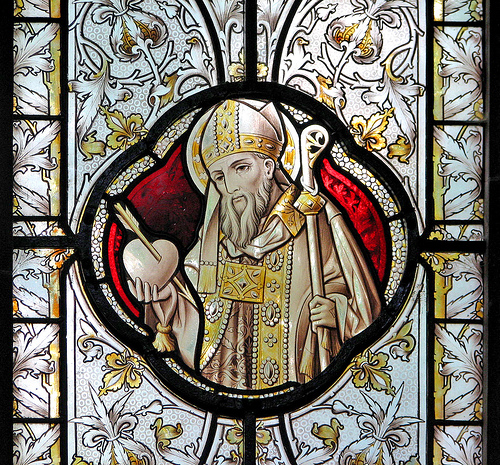
Augustine and his symbol of a heart, in a Victorian stained glass window

What is “the religion of the heart”? Where did it come from among Christians? And why have there been Christians of this sort ever since the earliest days of the church? 

I had the pleasure this past weekend of talking about this topic with a group of senior saints who are committed to the history of the Swedish Baptist Pietists; this is the denomination of my seminary, Bethel, in St. Paul, Minnesota. If you’re interested in the role of emotion in spirituality or have wondered about this pre-evangelical movement of “Pietists” that began during the period of the Enlightenment, then you may enjoy these remarks. Here’s part I:

Some remarks on Pietism and Heart Religion, in a historical key

The modern critique of heart religion

The first thing to say, perhaps, about heart religion, is that just as it got a bad rap in the 1600s, when Pietism was born, it still does today. Now, decades after the heyday of the charismatic movement brought heart religion to Main Street, the vaguely disreputable aura of an emotionally expressive religion lingers. Emotional commitment to, and expression of, one’s religion still seems, even to many evangelicals, somewhat uneducated and ‘un-necessary.’ Continue reading

C S Lewis and “medieval morality”


The following are some thoughts on how C S Lewis will figure as a “guide” into the look and feel of the “moral fabric of the Middle Ages,” and how that fabric differs from our own. It’s basically me grinding away at the grist for this Medieval Wisdom for Modern Protestants book.

My argument in this chapter is not that Christianity—either in the medieval period or any other period—has taught some distinctive morality, or even that it taught that morality in a distinctive way (although it did, from the earliest years of the church, as Robert Louis Wilken persuasively argues in The Spirit of Early Christian Thought). Rather, my argument is that today, Protestants, especially evangelicals, have fallen so in love with Luther’s (Augustine’s) message of grace, and have so spiritualized their faith (I almost said Gnosticized, and sometimes I wonder) that questions of morality have receded from view. So we need to hear again from a time (the Middle Ages) when Christianity structured not only people’s worship, but also their moral lives. Continue reading

Zinzendorf’s lecture #5–That Aspect of Faith Which Actually Makes One So Blessedly Happy


Here is a brief summary and commentary on the fifth lecture of Nicolaus Ludwig Count von Zinzendorf, Bishop of the Church of the Moravian Brethren, from Nine Public Lectures on Important Subjects in Religion, preached in Fetter Lane Chapel in London in the Year 1746.  Translated and Edited by George W. Forell, Iowa City, University of Iowa Press, 1973.

Again, this was from early in my graduate experience, from 94-95, in Dr. Richard Lovelace’s class on the Pietist Renewal at Gordon-Conwell Theological Seminary.

Lecture V–That Aspect of Faith Which Actually Makes One So Blessedly Happy

‘In the fifth, I have spoken of the main point which makes a believer blessedly happy [selig].’ (xxxii)

Text:  I Cor 13:2 alt [Last phrase is end of 3rd verse.] ‘And if I have prophetic powers, and understand all mysteries and all knowledge, and if I have all faith, so as to remove mountains, but have not love, I gain nothing.’ Continue reading

“I laughed, I cried, I changed”–sentimental narrative in early evangelicalism


Here is the fourth of my Christianity Today history website series “Grateful to the Dead: The Diary of Christian History Professor” For the rest of the series, click through the link in the first paragraph, below, to the previous installment. You’ll find links to the first two articles in the series are embedded early in that article:

#4: “I laughed, I cried, I changed”
Chris Armstrong

Dear folks,

In the last installment, I promised to tell you about a tradition in Western philosophy and literature that highly valued our shared nature as emotional beings and affirmed that reading about other people’s experiences and emotions can be a powerful transformational tool.

My “Exhibit A” is the 1764 book An Authentic Narrative of some Interesting and Remarkable Particulars in the Life of John Newton. As I prepared a discussion for our Patron Saints class at Bethel on this spiritual autobiography of the author of “Amazing Grace,” recently reissued by Regent College Publishing, I realized something: Newton‘s book is a clear example of a popular 18th- and 19th-century literary genre: the sentimental narrative.

What was a “sentimental narrative?” Continue reading

Sharing stories from the heart: can reading about the lives of others really change us?


Here is the third of my Christianity Today history website series “Grateful to the Dead: The Diary of Christian History Professor” Links to the first two articles in the series are embedded early in the article:

#3: Sharing Stories from the Heart
Chris Armstrong

[Back in the first installment of this diary, I interacted with the Emergents’ fear that evangelicalism’s entrenched, conservative church culture is just not reaching a young generation. Deep in writing my own “Patron Saints for Postmoderns” course, book, and blog, I suggested that the time might be ripe for telling and hearing stories—in particular, stories of our “foreparents” in the faith. Why not turn to the historical cloud of witnesses and see how they engaged their own cultures? That would seem to be one good way to learn how to translate the gospel for our own cultural moment.

[In the second (most recent) installment, I defended this idea of translating the gospel for new cultural situations against one potent objection: that such translation involves a dangerous compromise. When we set out to do such a translation, say some critics, we are allowing sinful human cultures to set the terms of the discussion. We are adapting and compromising Christ’s essentially countercultural message in illegitimate ways. The church, as Stanley Hauerwas and others argue, should be its own culture. My answer to this objection was to try to bridge the “translators” and the “separators” with a kind of ecumenical position that sees value in both approaches.]

Dear folks,

Perhaps, if you have read the first two installments of this “diary,” you are ready to launch into a lifetime of fruitful biography- and history-reading. But some of you may still be standing on the path, obstructed by one more roadblock: the postmodern claim that the cultural frameworks that have formed us as individuals so strongly condition and define us, that the experiences and ideas of people from other cultural frameworks (that is, other places or times) can never really speak to us or help us. Continue reading