Tag Archives: faith and reason

Another layer of the onion: “Imperial accommodation”–all bad?


Cover of "Christ and Culture"

I'm a "Christ above culture" guy, but that doesn't mean I ignore the evils of a culture-accommodated Christianity

Reader David responded to the post with the following:

While I agree that Constantine is not the whole story of the development of Christendom.  In my understanding, he is but one step – a formative one –  in a longer slide toward Christendom (which is not the same as saying “perfect before/all bad after.” I think we need to at least characterize this shift as my friend Alan Kreider does from the imperial accommodation of Christianity (Constantine) to imperial adoption of Christianity (Theodosius). There is a  difference between declaring religious tolerance of Christianity and making it the Imperial religion.

To me, this is an important distinction. As I responded initially to David: Continue reading
“Do not feed the fundamentalists”: The Smithsonian manages to engage creationists in civil dialogue! Stop the presses!


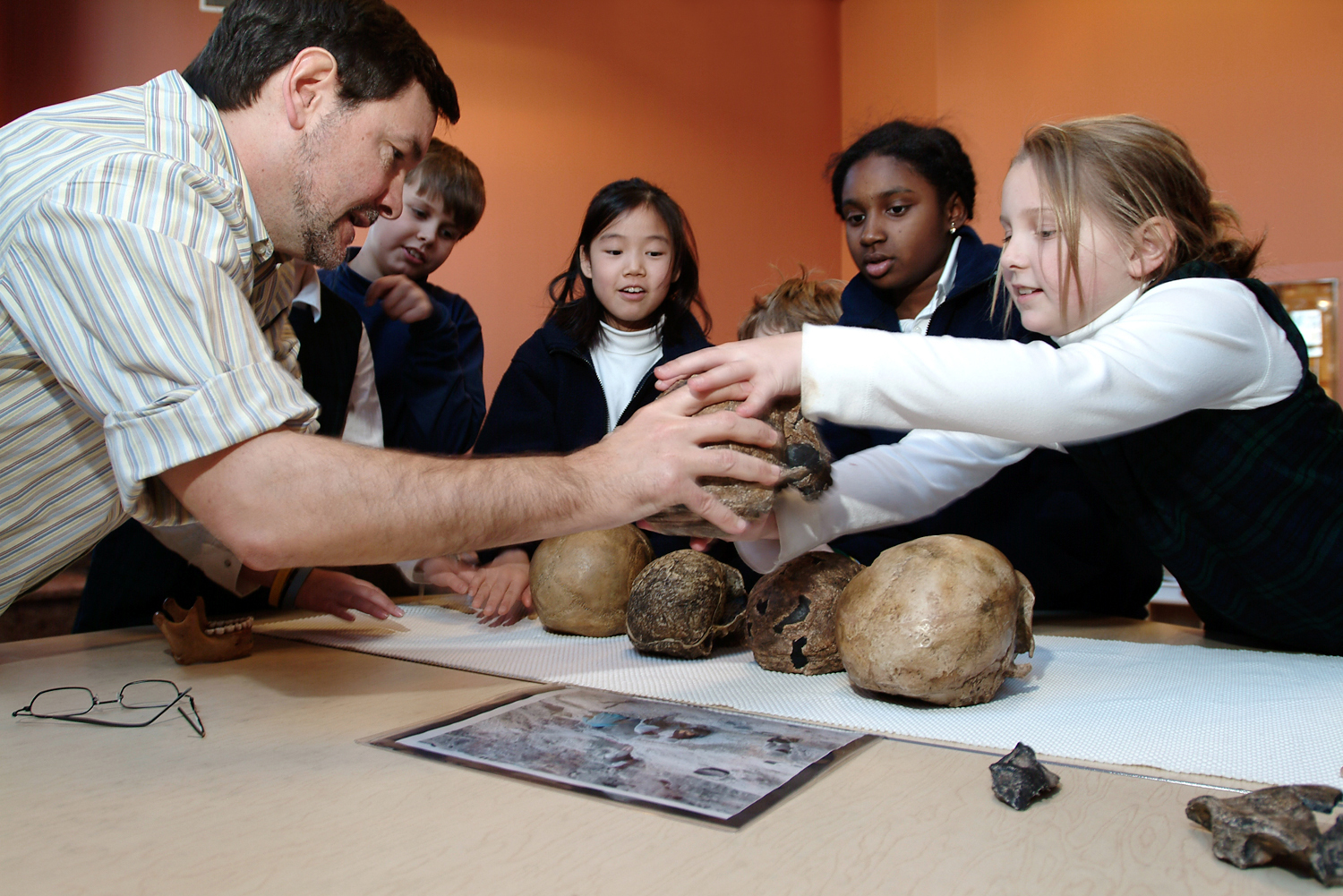
The Smithsonian’s National Museum of Natural History appears to have posted an invisible warning–perhaps more for its staff than its visitors. The implied sign resembles the familiar zoo warning: “Do not feed the bears!” Only it is not bears that worry the custodians of this temple to science, but rabid creationist fundamentalists.

What surprises scientist and Huffpost writer Alan I. Leshner is not so much that creationists go to the museum’s exhibit of early hominids as that the museum manages to draw them into (gasp) civil dialogue. Here’s a bit of his take from the article:

The exhibit — including a wealth of physical evidence, from fossilized skulls to stone tools — reveals without ambiguity how hominids have gradually evolved over millions of years. Of course, this evidence stands in sharp contrast with the creationist view that God created the Earth and all its inhabitants, virtually simultaneously, between 6,000 and 10,000 years ago. Continue reading

The supposed warfare between science and religion: A historian of science speaks out


The interview with eminent historian of science Dr. David Lindberg excerpted here first appeared in issue #76 of Christian History.

The Christian Face of the Scientific Revolution: Christian History Interview – Natural Adversaries?
Historian David Lindberg shows that Christianity and science are not at war – and may never have been.
David Lindberg

Has Christianity always warred with science? Or, conversely, did Christianity create science? CH asked David Lindberg, Hilldale Professor Emeritus of the History of Science and currently director of the Institute for Research in the Humanities at the University of Wisconsin.

And he should know. Lindberg specializes in the history of medieval and early modern science, especially the interaction between science and religion. His Beginnings of Western Science (University of Chicago Press, 1992) is an oft-translated standard in the field. He is also currently the general editor, jointly with Ronald Numbers, of the forthcoming eight-volume. Cambridge History of Science

Many people today have a sense that the church has always tried to quash science. Is this, indeed, the case?

This view is known as the “warfare thesis.” It originated in the seventeenth century, but it came into its own with certain radical thinkers of the French Enlightenment. These people were eager to condemn the Catholic Church and went on the attack against it. So, for example, the Marquis de Condorcet (1743-1794), a mathematician and philosopher, assured his readers that Christianity’s ascension during the Middle Ages resulted in “the complete decadence of philosophy and the sciences.” Continue reading

Galileo’s trial NOT a clash between science and religion. Get over it.


Portrait of Galileo Galilei by Justus Susterma...

Galileo Galilei

“The notion that Galileo’s trial was a conflict between science and religion should be dead. Anyone who works seriously on Galileo doesn’t accept that interpretation anymore.”

So says Thomas Mayer, a historian at Augustana College in Rock Island, Ill. Here’s a clip from the article:

Records riddled with holes
The Roman Inquisition began in 1542 — 22 years before Galileo’s birth — as part of the Catholic Church‘s Counter-Reformation against the spread of Protestantism, but it represented a less harsh affair than the previously established Spanish Inquisition.

Galileo’s first trial ended with the Inquisition issuing a formal order, called a precept, in 1616 demanding he stop teaching or defending the heliocentric model. His decision to ignore the precept ultimately led to the second trial 15 years later.

But some people have argued that Galileo never actually received the precept from the Inquisition. By their logic, the astronomer misunderstood the formal order as a mere rap on the knuckles. Continue reading

Five reasons I like Bell’s Many Mansions, and you should too


In a previous post, I introduced David Bell’s wonderful account of Western and Eastern medieval theology: Many Mansions. Now, with an eye (frankly) to trying to get as many of you as possible to buy it, I present my five favorite things about the book:

1. At regular intervals, Bell’s wit as well as his wisdom shines through. In introducing scholasticism he says, “Good scholasticism can be an extremely useful and revealing tool: a razor-sharp scalpel to open up the mysteries of salvation. Bad scholasticism—and there was a great deal of it—serves only as an antidote to insomnia.” “[Gilbert of Poitiers] bears the distinction of being the only person attacked by Bernard of Clairvaux whom Bernard failed to have condemned.” And in explaining Gregory Palamas’s distinction between God’s unknowable essence and his knowable energies: “My students in my classes may know ten percent of me; my friends may know seventy percent of me; my cat may know ninety percent of me—but it is only I, I alone, who can know all of me.”

Continue reading

Marilynne Rouse: “What is man that thou art mindful of him?”


Marilynne Robinson is a Christian and a deep thinker (this very conjunction may shock some). She is a Pulitzer Prize-winning novelist (Gilead, Home) and leader in that great thrumming Midwestern engine of the American fiction scene: the Iowa Writer’s Workshop. She has taken to heart the traditional Christian insistence that we have been given minds, the faculty of reason, as God’s highest gift, and that we must thus steward them well–see this post, point #6. Now she is training her focus on the mind itself, against certain reductionistic genetic approaches (she calls these “parascientific.”) I link here a recent article in Commonweal, which is taken from her new book, Absence of Mind (which is now Amazon’s #3 “religious nonfiction” book).

A mentor sent me this same link, saying in his email “If you set out to read this, disconnect the phone, sit up straight, and lock the door.” Indeed. She traverses rocky philosophical terrain in engaging the “parascientists.” But she does it with tremendous beauty and potency. Though I have a PhD (granted it’s in one of those fuzzy-headed humanistic disciplines), I had to “blip” through parts of this, as one of Charles Schulz’s characters once said he had to with the Russian names in a Dostoevsky novel. But it was worth the extra time and thought.

A few tastes of the essay follow, but I recommend you simply disconnect the phone, etc., and then click the link above and read the whole thing for yourself:

The strangeness of reality consistently exceeds the expectations of science, and the assumptions of science, however tried and rational, are inclined to encourage false expectations. Continue reading

Many Mansions: A splendid introduction to Christian thought in the Middle Ages


I’m currently reading Many Mansions: An Introduction to the Development and Diversity of Medieval Theology, by David N. Bell of Memorial University, Newfoundland. The volume also includes a host of medieval images selected and described by Terryl N. Kinder. The book is from the excellent Cistercian Studies Series (#146) (Kalamazoo, MI: Cistercian Publications, 1996).

This is a rare book in the field of introductions to the history of Christian thought, in that it deals with both medieval Western and Byzantine (medieval-era) Eastern theology in a clear, compelling, accessible manner appropriate for use in an undergraduate or graduate classroom—though students in either may occasionally have to look up words that the author uses without glossing; part of a winsome and erudite style. Continue reading

A pioneer of social ministry in an early evangelical revival: August Francke


I’m posting a few things related to that proto-evangelical movement of church reform and revival, German Pietism (17th & 18th c.). A couple of these posts (here and here) relate to one of Pietism’s most intriguing and influential figures, August Hermann Francke. So here is a biographical sketch of Francke:

THE LIFE AND WORK OF AUGUST HERMANN FRANCKE (1663-1727)

I want you to note two things: First, his learnedness and commitment to education (though he asserted paradoxically that a learned man is the hardest to get into the kingdom), and second, his pursuit of social ministry (the orphanage and many related enterprises). These facts seem to contradict the common stereotype of Pietism as a movement both brainless and inward-turned.

August Francke was born in 1663 and grew up in an area of Germany that was a stronghold of the teaching of Johann Arndt [on whom, another post for another time! He was a pre-Pietist spiritual teacher whose book True Christianity inspired Pietist leaders]. Something of a child prodigy, Francke had studied, by the age of 16, philology, philosophy, Greek, logic, metaphysics, geography, history, and Hebrew. He was a linguistic genius—by his death he knew some 35 languages. Continue reading

Religion & science post #3: Christian fathers of the scientific revolution, and more


Third and final post on religion & science, at least for today. The following is the candy bowl of factoids I compiled for the front of Christian History Issue #76: The Christian Face of the Scientific Revolution. Included is a list of “fathers of modern science,” all of whom explored science out of Christian motives:

The Christian Face of the Scientific Revolution: Did You Know?
Interesting and unusual facts about Christians in the scientific revolution.

Astronomer by Night, Canon by Day

When Nicolaus Copernicus wasn’t redrawing the celestial map, he held down a day job as a Catholic canon (ecclesiastical administrator). As the Reformation grew rapidly and extended its influence in Poland, Copernicus and his respected friend Tiedemann Giese, later bishop of Varmia, remained open to some of the new ideas. Continue reading

Religion & science post #2: The Christian DNA of modern genetics


The “fathers of modern science”–that is, men (very few women) in the 17th century who launched the specialized fields of study within the hard sciences–were almost all Christians who studied science to “think God’s thoughts after him.” I’ll post again listing their names and fields. But one of the most fascinating cases of the NON-conflict between science and Christian faith was the monk Gregor Mendel, whose researches helped found the modern science of genetics. I dug up some info on Mendel for a Christian History e-newsletter. As with many of these posts from my Christian History days, you’ll probably find that the links are out-of-date and possibly non-functional. But the story is still a fascinating one, I think:

The Christian DNA of Modern Genetics
Though open to frightening ethical abuse, genetics has been a Christian vocation since Gregor Mendel did his famous pea-plant experiments in the mid-nineteenth century.
Chris Armstrong

If canonization as a saint were—as some observers fuzzily imagine—a sort of Rotarian medal for service to humankind, the nineteenth-century monk-scientist Gregor Mendel (1822-1884) would have gained the honor long ago.

Of course, these days, not everyone may be so happy about placing a halo over the man who shows up in school science texts as the father of modern genetics. Recently, a few bad apples have been threatening to spoil the whole harvest of genetic science with wild claims about human cloning‘s potential benefits. If we bought the theories of some biological determinists, we would need only to get our hands on Saint Gregor’s relics—just a cheek cell or two would do—and we could create a whole army of scientific geniuses. Continue reading