Let’s jump right in. I’m going to frame each of these four issues in the form of a question that may stand between us and a sense of Christian vocation in our work.
Here’s the first question that may be nagging us as we seek a sense of vocation in our work:
Does time dedicated to working in the secular world endanger our souls?Is there an inherent tension or contradiction between the “worldliness” of work and the “spirituality” of faith?
A century or two before the opening of the Middle Ages, the theologian whose influence would become definitive for the next thousand years, Augustine of Hippo, distinguished two spheres of human endeavor: the “active life”—our work in the world—and the “contemplative life”—our private worship and prayer. The active life could be good, but the contemplative life, such as that enjoyed by monks and nuns, was much better—and indeed safer for our souls.
Augustine’s bifurcated view of work has persisted in some circles right up to this day – but it was quickly challenged by the man some consider the spiritual father of the medieval church, as Augustine was its theological father.
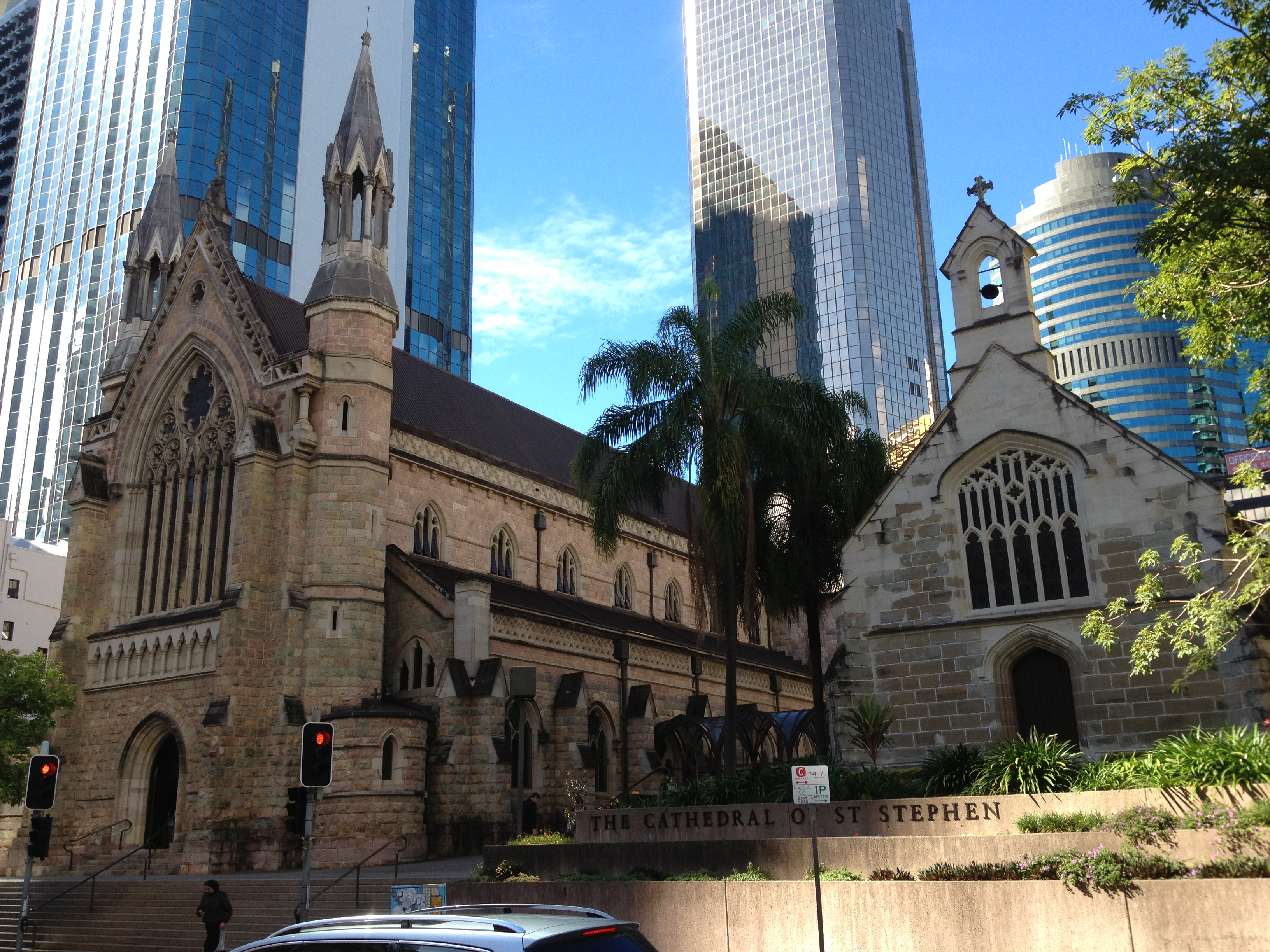
Cathedral of St Stephen, Brisbane; wikimedia (creative commons)
A couple of years back, in the depths of the COVID pandemic, I was invited by Sioux Falls Seminary to address an international group of their students via Zoom on a topic related to faith and work. Reflecting on the assignment, and aware that I would be addressing workplace Christians studying for ministry in one of the most innovative seminaries in the world (which has now spread globally and renamed itself Kairos University), I decided to address the “sacred-secular divide” that many experience acutely in their working lives. The resulting talk draws on four historical figures who addressed this divide in various ways. Here it is, in five parts:
This past January, I was co-teaching a group of graduate students at Regent College, in Vancouver, BC, with that wise and humane thinker on faith and vocation, my friend Steve Garber. Steve had asked me to join with him in creating and teaching a course for Regent called “Models of Public Engagement.” My contribution was to provide readings, mini-lectures, and discussion prompts from a wide variety of historical people of Christian faith. By the class’s second day together, in our Vancouver intensive week during which it would snow, rain, and blow gusts of freezing wind every day, it had already become a class joke that all of Dr. Armstrong’s best friends are dead.
This is actually not far off the mark. You can find my blog-site, for example, at “gratefultothedead.com.” (This, by the way, has confused more than a few Grateful Dead fans, who have wandered onto the blog expecting to find me writing about Jerry Garcia.)
But I can’t help myself. I love introducing people to my friends. As a wise priest once said to me, the teaching gifts of our past leaders have a very long shelf life. Yes, and I’d add, their lives as well as their teachings can also still speak to us today. So this afternoon as we dive into a few questions about how to find Christian vocation in a working world where Christ is so rarely named, I’ll be sharing with you from the thought and lives of four of my best dead friends. These are Gregory the Great, John Wesley, Charles Sheldon, and C. S. Lewis.
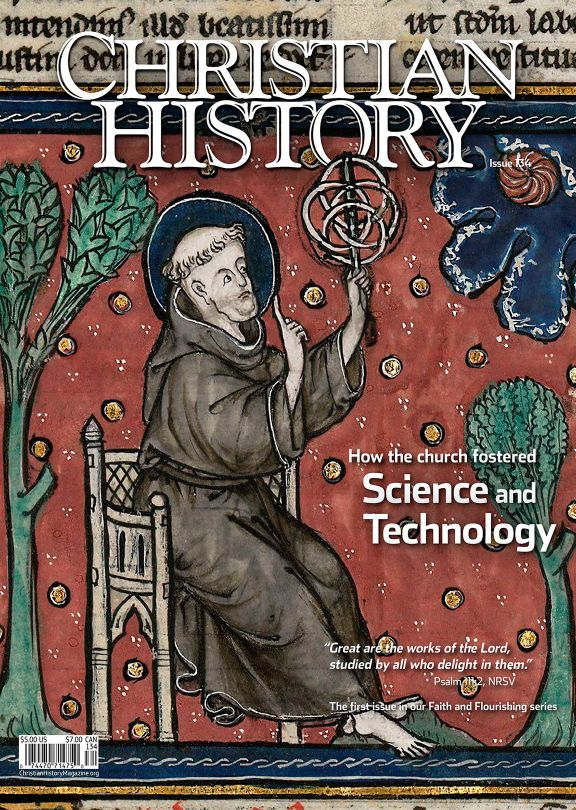
For those who enjoyed my faith & science history series over the past couple of weeks, there’s a treasure trove awaiting: The recent Christian History issue(s) on the same topic. You can browse the issue in full color and download pdfs of individual articles here.
Which reminds me to say . . .
. . . if I had a nickel for every time someone has said they didn’t know that Christian History had re-started after its then 26-year run ended in the fateful year 2008 . . . well, I’d be able to buy a fancy coffee or two. And little did anyone know – leastwise the magazine’s editors and parent (non-profit) organization – that in 2022 we’d be cruising into CH’s 40th anniversary year (special anniversary issue coming – keep an eye out at this link!).
But since 2011, the magazine has indeed lived again – and what a run it’s been, under the indefatigable editorial leadership of scholar/editor/writer/priest extraordinaire Jennifer Woodruff Tait. Among the topics we’ve covered just in the past few years: America’s love affair with the Bible; CS Lewis’s friends & family and their influence on him; Christian support for the common good in science, healthcare, higher education, the public square, and the marketplace; Christianity and Judaism; plagues and epidemics; Latin American Christianity; the women of the Reformation; the Quakers . . .
And for those interested in topics churchly/scientific, check out the following issues:
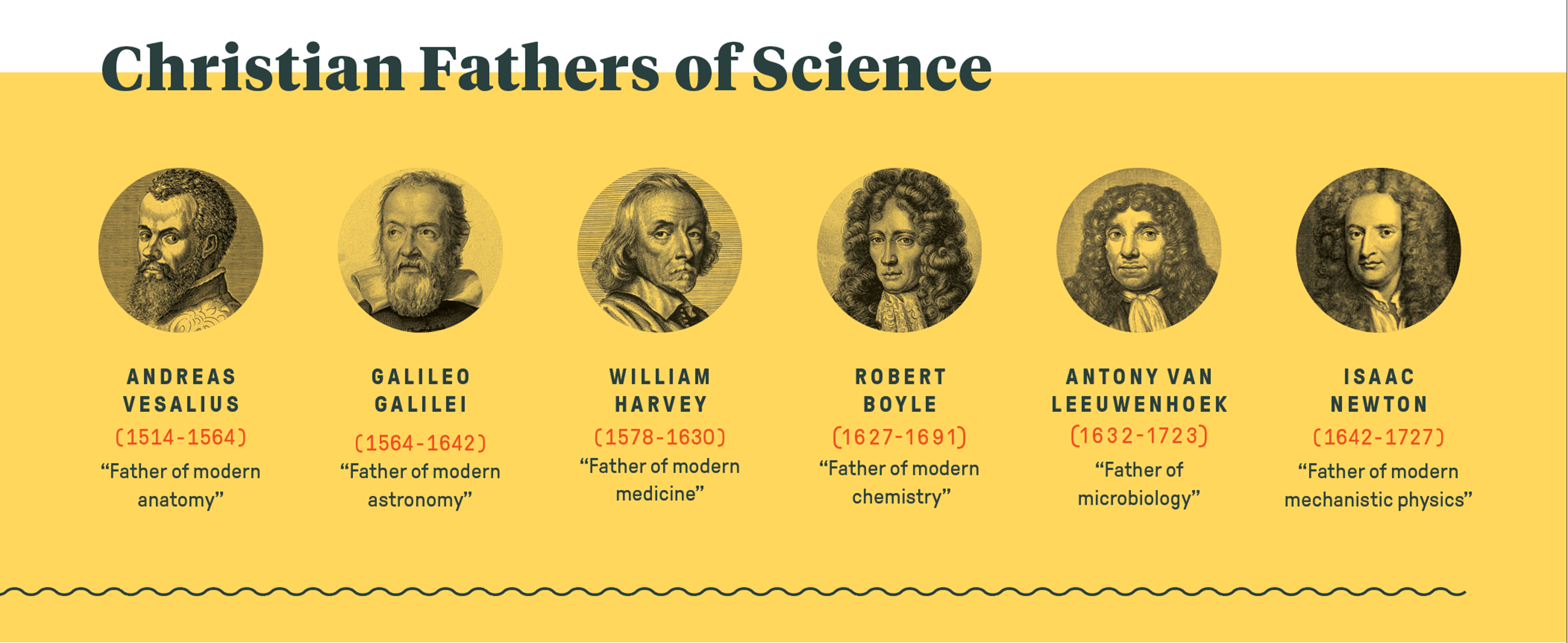
Illustration from C Armstrong, “The Pursuit of Science for God and Neighbor,” Common Good magazine issue #3, pp. 48-53
For many years I’ve attended – and sometimes spoken at – the Acton Institute’s annual four-day June meeting, “Acton University.” The 2022 meeting will happen June 20-23 both in-person in Grand Rapids and online. I’ll be giving a talk there titled “Christian foundations of science & technology innovation: A story in ten facts.” Here it is:
I’d like to start our reflection together with a question about finding Christian vocation in this tremendously important sector of modern work: science and technology.
Christians today are often told that we must bridge the so-called “sacred-secular divide” by finding divine purpose and mission in our daily work. And that sounds good in theory. It certainly has good support in both Scripture and tradition—from the Apostle Paul to Gregory the Great to Martin Luther and beyond. But where it often runs aground is in our actual experience.
Because, truthfully, our modern work contexts, and even the nature of the work we do in those contexts, seems to many of us—for many reasons—about as secular as can be.
So here’s the vocation question: How can we discover Christian vocation in fields of work that Luther could not have even imagined—let alone the Apostle Paul? In particular, how can modern people of faith experience work in the scientific laboratory or the high-tech firm as Christian mission?
I find in C S Lewis a modern person who, throughout his life, lived and worked according to this medieval-inflected, sacramental, incarnational way of seeing and being. So it may be worth looking at a few ways he did that. We can start, again, with his imaginative writings. One is reminded, for example, of the wonderful image of a loving and materially comfortable domesticity in the beaver family portrayed in Lewis’ The Lion, The Witch, and the Wardrobe — which in turn was so like the similarly convivial, rustic life of his friend Tolkien’s hobbits in the Shire with their love of pipes and parties and meals together. Or his novel That Hideous Strength, which is from one end to the other a defense of the real holiness of ordinary virtues of embodied life — work, married sexuality, household life, and all — against the gnostic technocrats who would strip away all material mediations of sacred meanings and virtues in our ordinary lives.
In his letters, too, you can often find Lewis celebrating the sacred in the materiality of our ordinary life and work, even as he recommended to his correspondents that they read medieval writers for the good of their souls. He liked to sign his letters with that very embodied moniker Saint Francis of Assisi had used for himself: “Brother Ass.” And in one of those letters to a sick friend, he said of his own aging and increasingly malfunctioning body: “I have a kindly feeling for the old rattle-trap. Through it God showed me that whole side of His beauty which is embodied in colour, sound, smell and size.”
Recently I read several dozen articles from the Chronicle of Higher Education from the past few years, diagnosing “the moment” at which faculty find ourselves.
At the same time, I was re-reading my notes from a recent gathering of theological educators (people forming the next generation of pastors) I hosted–also to “diagnose this moment” at institutions with such programs. I asked about theological educators’ current sense of their vocations and their careers. Where are faculty in this specialized area finding themselves these days? Early on the first day of conversations, these factors emerged:
Anxiety with changes, transition to virtual work – is this real education? Am I doing it well? Not as satisfying. Missing potential for formation?
Sense of living and working in a time of transition – everyone knows education is ripe for disruptive innovation
Identity: am I simply a professor or also a mentor, coach, something else? – transitions in teaching [and I’d add: student needs and preferences in education] lead to questions of identity
The need for rest, with some burnout: schools have tighter budgets, are asking people to do more
New opportunities, flexibility to relocate, work from home, be near family, flourish in new ways, get in front of new audiences and address issues, needs, concerns beyond the traditional seminary (etc.)
As I read these notes, I was getting a strong feeling of déjà vu – where had we seen a combination of factors similar to this before? And it dawned on me: this was reminding me of David Miller’s characterization of the 1980s-90s in America, the rise of the “third wave” of the faith and work movement, and his description of the factors and pressures that led boomers to turn to questions of spirituality related to their work (both new age and traditionally religious), in search of a revived and restructured identity and a recovered satisfaction in work [in his book Got at Work]. I went back and re-read the main section of Miller that dealt with this and that made the link between vast changes in the business sector (in particular) and an increased focus on “spiritual” issues related to work. I’m pasting it below, then I want to draw out the parallel with today’s higher ed situation and faculty’s experience.
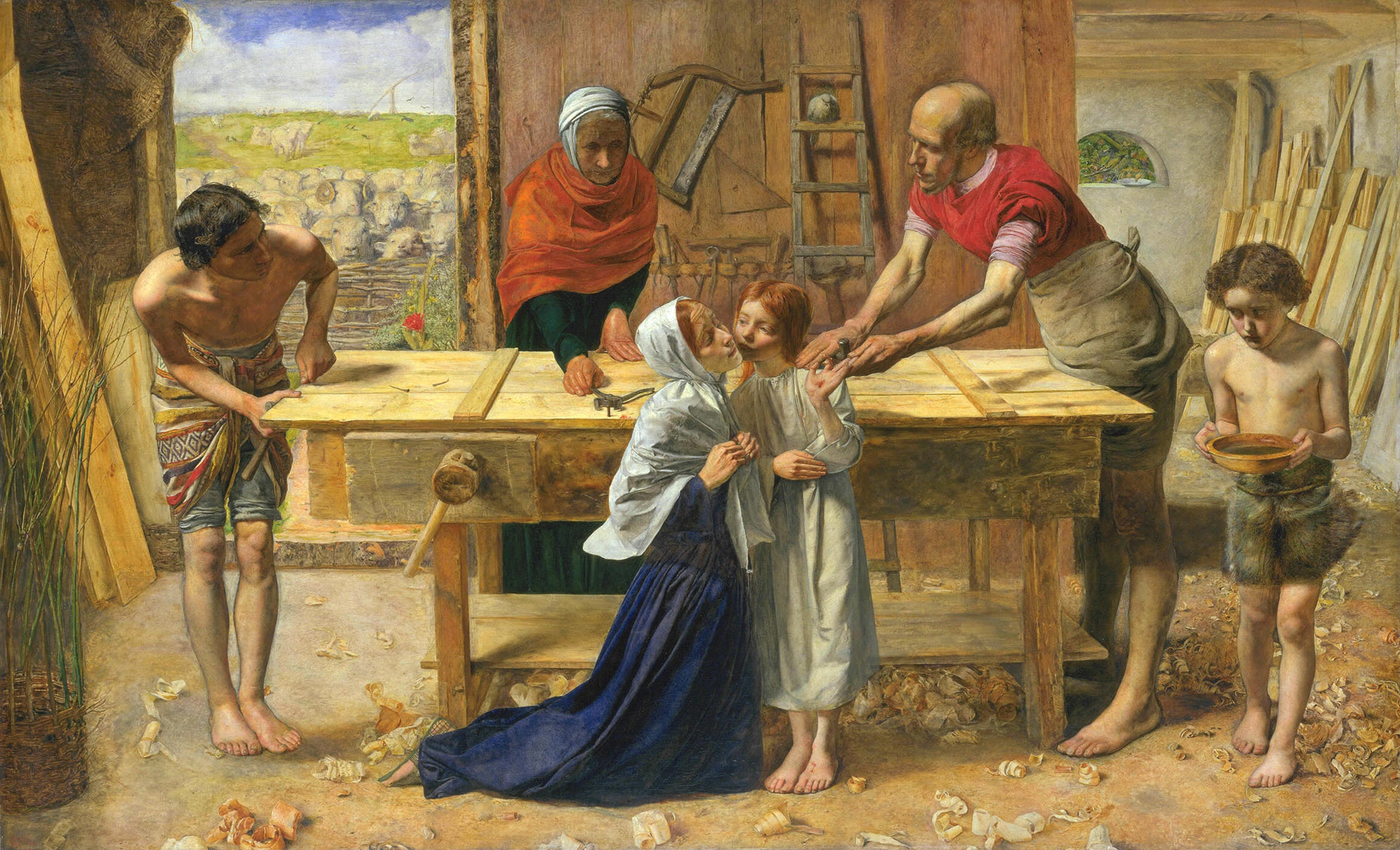
John Everett Millais – “Christ in the House of His Parents (`The Carpenter’s Shop’)”; Wikimedia Commons
I commend to you Common Goodmagazine. There is nothing else like it out there. And yes, though there is an online version, it contains only a modest part of what appears in the (beautiful and award-winning) print version. Seriously, you should subscribe.
In the current issue, #08, I have an article titled “The Work of Genesis: How the doctrines of creation and incarnation shine light on our earthly vocations.” Since my pieces tend not to make it into the online version (not sexy enough, I guess??), I’ll share this as a prod to subscribe:
The Work of Genesis How the doctrines of creation and incarnation shine light on our earthly vocations
Though many of us seem to have forgotten it in our post-Christian age, “vocation” is a Christian word. And by “vocation,” the historic church — especially the Protestant tradition — has meant something like this: Meaningful work that fulfils both the Genesis mandate to cultivate and keep the earth and the great commandment to love God and love and serve our neighbors. Taking this definition, vocation finds its roots in the doctrines of creation and incarnation.
The theology of the world operative within Christian humanism has been not just a theology of material creation or nature. It has also been a theology of the human, social world in which we live, and which Christian humanism navigated through the culture-creating development of such areas of our life together as ethics, law, and both political and economic theory and practice.
Scholastic humanism and the social world
For example, in parallel to the scholastic humanists’ pursuit of natural philosophy (as science was then called), and at first surpassing it in its power to bring order and peace to the world, was the study and systematization of law. Of course in that Christendom age, that law was religious, or “canon” law. This connection had deep historical roots – when in the 4th century the Benedictine monk Gratian had combined “the theoretical principles and legal procedures of the existing Roman law code with the content of ecclesial canon law,” he was providing “the first basic, universal textbook in response to the growing need for the legal administration of emerging Christendom” – and not surprisingly, it was the papal courts that became the ultimate recourse for most matters, fatefully cementing the church’s political as well as spiritual power.[1]
The scholars whose trust in human reason underwrote their approach to these social dimensions of flourishing (and science too could certainly be included as having a strong social dimension) grounded this trust not only in the doctrine of creation, but also – not surprisingly – in “the concept of the incarnation as God’s reconciliation with creation and his most intimate fellowship with humanity.” The resulting “medieval synthesis” “wove nature, humanity, reason and religion into a meaningful tapestry of ennobling purpose that was central to medieval theology from the twelfth century onward.”[2]
In sum, the three powerful legs of this great platform of scholastic humanism were “[the assurance of] God’s love, the intelligibility of creation and the trustworthiness of human reason.” And on this platform, medieval Christians built the foundational institutions of Western societies—the hospital, the university, a nascent scientific establishment, a growing artistic establishment, the superstructure of European law, and more.[3]
Saint James as a Pilgrim with a Purse and Staff (detail), Workshop of the Bedford Master, Paris, about 1440-50, Book of Hours (text in Latin). The J. Paul Getty Museum, Ms. Ludwig IX 6, fol. 203v
Skipping ahead, from the 11th through the 13th century, a new phase of Christian humanism arose – in the thought and work of “scholasticism” – a movement in Christian thought that is understood by historians to have its intellectual foundations in Augustine, its early formulation in the work of Anselm of Canterbury in the 11th century, and its pinnacle in the grand system of Thomas Aquinas in the 13th.
The medieval scholastics continued and intensified the high humanist evaluation of human reason. As historian of science Edward Grant has comprehensively shown, no line can be drawn between the Middle Ages as a supposed “age of faith” and the 17th and 18th century “age of reason,” for both ages shared “the profound conviction that their beliefs could be reasonably demonstrated” and “medieval university scholars and teachers . . . placed a heavy reliance on reason,” and in fact, “in the history of civilization, they were the first to do so self-consciously on a grand scale.” Building on over a millennium of Christian thought about the Genesis portrayal of the imago dei, passed on from patristic thinkers such as Justin Martyr and Augustine of Hippo, the scholastics argued like this:
Workers in a building in Sao Paulo, Brazil; by Guilherme Cunha, Unsplash, free use
First, my apologies to regular readers and subscribers for disappearing for a while. For the past 6-9 months (or more), this blog has been offline, for reasons still not entirely clear to me, but seeming to have to do with its attachment to an old email address to which I no longer had access. But even before that, I had for years not updated the blog on any but the most sporadic basis. I intend for that to change now, as I am working on a new book (on which, more anon) and will most likely blog through the process as I did with Medieval Wisdom for Modern Christians, published back in 2016. So, as a first shot across the bow . . .
[The talk from which the following is excerpted was presented by Dr. Chris R. Armstrong at the Ciceronian Society annual meeting at Grove City College in March, 2022. As always, this material is not to be reproduced or distributed in any form without the express permission of the author.]
Introduction: Disenchantment and the sacred-secular divide
The faith-work problematic
American Christians has been wrestling with a problem for decades. The problem is that many Christians in this country experience a separation in our lives between supposedly sacred activities and supposedly secular activities – and that furthermore our work, which may in the end account for some 100,000 hours of our lives, falls largely in the latter category.
You may say, “Wait a minute – what about the torrent of books, blogs, websites, podcasts, and conferences on this subject in the last few decades? Are we really still unable to resolve this existential issue?” And I would respond, “Yes, because we still have no stable, faithful, well-worked-out theological understanding of what work is and how it relates to central teachings of our faith.”
In other words, despite some excellent scholarly treatments, the faith and work conversation remains largely ungrounded in three ways: philosophically, theologically, and importantly, historically. Having by the mid-nineteenth century discarded much of the Christian knowledge tradition, American Christianity—or at least, American Protestantism—now unsurprisingly finds itself with precious few resources to address what, at the very least, must be seen as a colossal failure of pastoral care.
In this paper, I propose that the longstanding and biblically faithful tradition of Christian humanism—a philosophy of culture that is faithful to central biblically derived doctrines—can and should provide this tripartite grounding, and that scholars who are engaging the faith and work conversation should be recovering and drawing from that tradition today.
This blog contains over 720 posts as of Oct 2020 (also over 518,000 views from 210,000 unique visitors since inception in June 2010). If you read something you like, odds are there are at least one or two other posts dealing with similar topics. Which is why there’s a search box right below this message. :)
Francis of Assisi--part of an altarpiece by Bartolomeo Vivarini, in the Brooklyn Museum
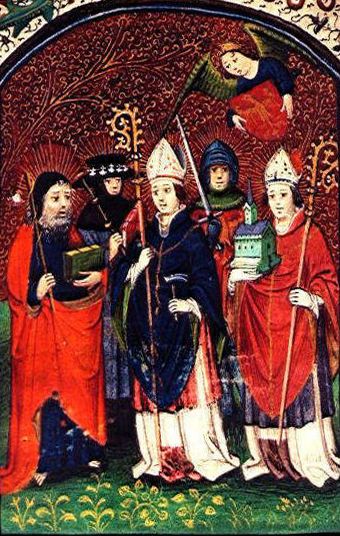
From a mid-15th-century Dutch prayerbook: Saint James the Great; Saint Joseph; Saint Ghislain, abbot of St Ghislain, near Mons; Saint Eligius; Saint Ermes (Hermes)
Gregory the Great and St. Mamertinus, from a 14th-century French translation of Jacobus de Voragine, Legenda aurea
Cologne Cathedral
The clocktower of the Saint-Leu-Saint-Gilles church in Saint-Leu-la-Forêt (Val-d'Oise), France
Masaccio, Crucifixion, 1426 (Naples, Museo Nazionale di Capodimonte); the blonde figure is Mary Magdalen




 Medieval Wisdom for Modern Christians





 Grateful to the dead