I posted yesterday a reflection sparked by Mel Gibson’s The Passion of the Christ. You might wonder: Why did Christians ever begin to focus on the gory details of Jesus’ last hours? Glad you asked! I explored that very question in a Christianity Today article:
The Fountain Fill’d wth Blood
Mel Gibson is drawing on a long tradition of Cross-centered devotion.
Chris Armstrong
Martin Luther, the founder of Protestantism, acted on the repeated urgings of his Augustinian confessor, Staupitz, to “Look to the wounds of Jesus.” And soon after posting his 95 theses, he announced that the only man who deserved to be called a theologian was he “who comprehends the visible and manifest things of God seen through suffering and the Cross.” All through his life, his sermons and hymns contained striking images of that event.
The German pietists and the Moravians who followed in Luther’s steps in the centuries after his death also practiced the Reformer’s near-mystical devotion to the cross. They wrote hymns filled with the most heart-rending depictions of the wounds and the sufferings of Christ. And British evangelicals like the Wesleys and William Cowper followed with hymns in a similar, if more refined, mold (think of Cowper’s “There is a fountain fill’d with blood, / Drawn from Emmanuel’s veins”).
This comes as a surprise to many, because Protestants have usually followed the image-averse John Calvin. He, though equally focused on the Cross, worried that any imagining of the Crucifixion might become an idol, distracting the believer from God himself.
Thus the “gorier” pietist and Moravian hymns have now, with the almost solitary exception of Paul Gerhardt’s (d. 1676) “O Sacred Head Now Wounded,” been pushed from most current hymnals (even Moravian ones). And when we run across the sort of vivid portrayal of Christ’s passion that Mel Gibson presents in his movie, something in us recoils: Is this not excessive and morbid? Why dwell on the horrific details? Surely Jesus would want us to turn quickly from Good Friday to Easter, placing our focus on his glorious resurrection!
We find it difficult to enter the world of another time—to understand its art, its jokes, its characteristic devotions and valued emotions. Never is this more true than with the vivid, bloody, even repellant portrayals of Christ’s suffering embodied in the paintings, sculptures, preaching, poetry, and drama of the late medieval period. But this is where the whole subsequent history of Cross-centered devotion has its roots. And it is a tradition, for all its flaws, that has something to teach us still.
Life-sized Passion
In the period of persecution before Constantine, such leaders as Ignatius of Antioch (who eventually went eagerly to martyrdom) counseled believers to imitate Christ in his passion, resigning themselves to the sufferings of persecution, as he had done. After Constantine, however, the church focused on a triumphant, resurrected Christ. The earliest depictions of Jesus’ humanity, from the fourth century on, show him as a royal or imperial figure, and his cross, if shown at all, as jeweled or golden. The “Christus Victor” atonement theology of the day emphasized Christ’s triumph over Satan.
Christianity became fashionable under later Christian emperors, and the church began to look too much like the world. So men and women began retreating from society into solitary cells and small communities. These earliest monastics sought the road to true discipleship. And they saw their master and model, Christ, as the sacrificial lamb, mocked and slaughtered to redeem sinful man. Earnest disciples, in the East and later in the West, immersed themselves in the Gospel accounts of the Crucifixion, which they read over and over again in a daily cycle whose very “hours” represented key moments in Christ’s passion.
At the opening of the Middle Ages, however, church leaders such as Gregory the Great (590-604) still tended to highlight Christ’s divine dignity. It was again the monks, especially the early Irish and British monks, who sustained a special devotion to the cross of Christ and tried to imitate Christ’s sufferings with penitential disciplines, such as standing for long periods with arms outstretched.
By the 11th century, however, this special devotional attachment to the Passion began to spread beyond the cloister, as a new emphasis on affective (emotional) spirituality spread in the church. John of Fécamp (d. 1078), for example, begged Jesus to grant his desire that, because of the blood he shed, John’s eyes would flood with tears, his heart being made contrite. Anselm of Canterbury (d. 1109) asked Christ to forgive him “for not having kissed the place of the wounds where the nails pierced, for not having sprinkled with tears of joy the scars.”
Soon a new atonement theology came on the scene, one fit for the new emotional piety. Its author was Peter Abelard (d. 1142/43), who stressed that the Crucifixion provides not satisfaction for wrongs committed (as had Anselm) but rather the supreme example of Christ’s love and forgiveness. Abelard wanted to foster in the unbeliever emotions of horror and godly sorrow when confronted by this death.
The 12th century’s focus on affective devotion found its most important promoter in Bernard of Clairvaux (d. 1153). But the most vivid example of Passion-centered piety was still to come. This was Francis of Assisi, whose all-consuming imitation of Christ seemed rewarded on September 17, 1224, in the hermitage on Mt. Alverno, when he is said to have received the gift of Christ’s wounds in his own flesh—the stigmata.
Francis’s disciples in the next two hundred years brought the humanity and sufferings of Christ into the mainstream of devotion. From portable outdoor pulpits and within chapels whose walls were often covered with life-sized Passion scenes, the preaching friars stressed as never before the emotions of Jesus during his ordeal—and the answering emotions of the worshiper.
They also championed an ascetic approach that sought to follow Paul, who said, “In my flesh I am completing what is lacking in Christ’s afflictions for the sake of the church” (Col. 1:24). In the late-medieval heyday of Passion piety that followed, many monks, nuns, and layfolk tried in various ways to imitate Jesus’ passion or to experience something of the same extreme suffering as had their Lord.
At the same time, the laity picked up another spiritual practice that had once been the preserve of the monastics: the regular discipline of private prayer. The wealthy commissioned beautiful Books of Hours and other aids to help them meditate on the Crucifixion.
Gratitude and terror
According to medievalist Richard Kieckhefer, 14th-century Passion literature was supposed to evoke four primary reactions: gratitude, penance, compassion, and imitation. But these did not appear simply or discretely. Rather, terror, awe, sorrow, and joy might mix in one experience. At the center of all this emotion was the single goal that every believer sought; in the words of Kieckhefer, “a sense of profound contact with the deity that was joined with [Christ’s] humanity.”
Christians throughout the period from Bernard through Loyola wrote and read increasingly elaborate accounts of the Passion events. The man whose exegetical work opened the floodgates to these newly detailed narratives was Rupert of Deutz (d. 1129). A Belgian who died an abbot in Germany, Rupert mined not only the gospel accounts and a number of apocryphal accounts—all of which had been used before his time to tell the story of the Passion—but also a host of obscure passages in the Old Testament.
By an allegorical method of exegesis, Rupert found in the pages of Job, Psalms, Isaiah, and other books new and little-known details of the “Secret Passion” of Christ—the exact number of times he fell down en route to the cross, the drunken condition of Jesus’ tormentors in Caiaphas’s court (Rupert was no friend to the Jews), and so forth. The detail of the executioner’s ropes pulling Jesus’ body taut, for example, came from Psalm 22:17. After Rupert, historian Gerard S. Sloyan says, “A legion of visionaries took their lead from his writings,” elaborating an expanding cast of characters and litany of details of Christ’s suffering.
Late 13th- and 14th-century authors went one step further with entire comprehensive biographies of Christ that contained details from outside of the Gospels—most famously, the Vita Christi of Ludolph of Saxony (d. 1378). It was this book that eventually reached a swashbuckling young Inigo (later Ignatius) Loyola, founder of the Jesuit order, in his convalescence from a war wound, and turned his heart toward Christ. Ignatius wrote in his widely used Spiritual Exercises a set of directions on how to place oneself imaginatively in the scene of Christ’s crucifixion.
Loyola was working in the same tradition as the anonymous 13th-century author who wrote under the name of the historian Bede, who urged readers to place themselves on the scene of Christ’s trial—to plead with his tormentors, offer their own bodies to be beaten in his stead, and wait with him as he sat in chains, offering their shoulders for him to rest upon.
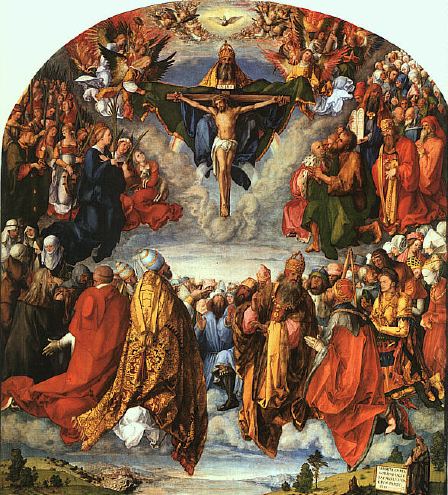
This same tradition founded such longstanding devotional practices as the Passion Play and the Stations of the Cross. And it was in this period that disturbingly graphic crucifixion paintings (by Hiëronymus Bosch, Albrecht Dürer, and Matthias Grünewald, for example) became much more common.
Fusing wisdom to the heart
The typical critique of such devotion is that it unduly separated the human and divine natures of Jesus, concentrating exclusively on the former. But for medieval believers, with their sacramental understanding of God’s presence in the material world, depictions of Christ’s wounded body only drove home the truth that in this man the divine became human.
A second critique is that such practices fostered an inward-turned, individualistic piety that was, as the saying goes, “no earthly good.” But medieval scholar Ellen M. Ross argues that, on the contrary, “the believers’ alliance of compassion with Jesus enabled them to perceive Jesus in other humans,” and to act compassionately for their benefit. The resulting works of mercy and practices of confessing one’s social sins, Ross concludes, helped build a strong, humane center holding together medieval society.
Underlying this very tangible, imaginative piety, Ross argues, was the belief that the best way to gain understanding is through experience. Both intuitive emotion and practical imitation infused wisdom into one’s very heart and body, in a way that speculative theology could never do. Spiritual leaders like the 14th-century English mystic Walter Hilton continued to teach—as Francis of Assisi had—that the Christian life must be lived out, practically, by imitating Christ’s example of charity.
Spiritual time travel
The desire for a tangible experience of God’s love has not dissipated with the discovery of the atom or the invention of the automobile. Modern Protestantism has given relatively little attention to our imaginative and emotional lives, yet the century just passed saw a dramatic upsurge of charismatic spirituality.
With its devotion to the person of Jesus, its impassioned worship, and its physical experiences of God’s intimate presence (tongues and “slaying in the Spirit”), this movement first sprung at the turn of the 20th century in a poor, multiethnic Los Angeles neighborhood, from a root in Wesleyanism’s “religion of the heart.” Then at mid-century it reemerged in mainstream Christianity—springing first from the Anglican and Roman Catholic confessions, with their sacramental and historical traditions.
But you don’t have to be a charismatic to awaken your imagination and your senses in devotion to Christ. Those who feel a lack in this area could do worse than to take Mel Gibson’s cue, and begin a time-traveling “spiritual research trip” to the roots of Cross-centered piety.
Not everything you find there will be helpful. Few of us will wish to emulate certain Irish monks by standing for long periods in a bucket of ice water, arms outstretched in a cruciform position. But it couldn’t hurt, with Martin Luther, to “look to the wounds of Jesus” to “comprehend the visible and manifest things of God seen through suffering and the Cross.”
Chris Armstrong is managing editor of Christian History, a CT sister publication.
Copyright © 2004 Christianity Today. Click for reprint information.


 Medieval Wisdom for Modern Christians





 Grateful to the dead