Tag Archives: work

How the Incarnation and God’s sacramental presence in all creation put our everyday work in a new light


English: Icon of Jesus Christ

Icon of Jesus Christ (Photo credit: Wikipedia)

What follows are two short theological-historical reflections on our daily work that ended up on the cutting-room floor when I handed in 6,000 words for a 3,500 feature on Christian thought about vocation that will appear in next month’s Leadership Journal. Since I still like these, I’m posting them here. The first is on what the Incarnation means to our work, with special reference to vocations in the arts. The second is on how God is present and communicating to us in every part of the created world in a way analagous to, though not the same as, his real presence in the sacraments.

Resources on work in early and medieval Christian thought

The Incarnation

Luther and other Reformers certainly did advance Christian reflection on work and calling. But if we turn again to the early and medieval church and look beyond the clerical and monastic usurpation of the term “vocation,” we will find some important theological resources for thinking about ordinary work—resources that Protestants today are in danger of losing entirely.

The appearance of Christ on the scene as a human being, with all the physical needs, skills, and temptations we all share, inserts a crucial principle into our thinking about work. The Incarnation meant that the church could not fall into the error of the Gnostics, calling the material world evil and thus leaving God out of consideration when we interact with the material world. In the second century such pastor-teachers as Irenaeus led the charge against this error, leading the church to reject Gnosticism as heresy.

Today we are in danger, not of viewing the material world as evil (most Western folk are little tempted to that error!), but of marginalizing our time-bound material existence as “non-spiritual.” Continue reading


What can REALLY help hurting workers: Greg Forster’s rejoinder to Jonathan Rauch


Having reflected in a previous post on Jonathan Rauch’s recent National Journal on the plight of many working and non-working American men today, I’m going to re-post here a response to Rauch. The original article may be found over at Hang Together.

Jonathan Rauch’s (Mostly) Failed Agenda for Hurting Workers – and What Would Work

College of the Ozarks’ “Hard Work U” Program

I see lots of attention being paid to this article by Jonathan Rauch on the economic crisis of America’s working class. He’s looking at the right problem, but he’s looking at it all wrong. As a result, he misunderstands both the cause and the needed remedy. Continue reading

Most American men, both in and out of work, are in DEEP trouble. Why, and what can we do about it?


KONICA MINOLTA DIGITAL CAMERAIt is no good to talk about “theology of work” and “faith-work integration” as if these topics somehow floated above the economic realities in which we live. Nobody has to remind us that those realities are pretty grim right now. But we can’t very well address them effectively with the resources of the church–or any other resources–unless we understand what’s going on in our economy.

Does this mean we need to be trained economists as well as pastors, seminarians, theology professors, engaged laypeople? Not at all. A chaplain or pastor can minister effectively in a hospital room without a medical degree. But it sure helps if said pastor has some idea of what challenges a patient might face within today’s medical system; what the patient’s prognosis is and what that will mean for their quality of life; and so forth. Just so with those Christians who today want to address work through eyes of faith.

This is one thing I respect highly about the Kern Family Foundation’s current grant-making activities in evangelical seminaries across the country: the foundation will not let seminaries get away with a surface-y, pietistic approach that majors on our individual gifts and vocations while ignoring economic realities. Indeed, the foundation and its seminary partners are now working toward a set of faith-informed “economic wisdom maxims” that are securely grounded in economic realities. I can imagine few more helpful enterprises in moving forward the faith-work conversation today.

Apropos all this, friend Collin Hansen, Editorial Director over at the Gospel Coalition, brought the following article to my attention. This piece by Jonathan Rauch in the top policy magazine The National Journal is sobering, to say the least. But the first step in solving a problem is knowing you have one. And right now, America has a very big one. Continue reading

Have you ever thought of what a truck driver goes through to get your Amazon package (etc.) to you?


DRIVER_IN_THE_CAB_OF_A_LARGE_CATTLE_TRUCK_IN_COTTONWOOD_FALLS,_KANSAS,_NEAR_EMPORIA._SUCH_VEHICLES_AND_HORSES_ARE_THE..._-_NARA_-_557044.tifI’d like to share part of a fascinating article (thanks to Drew Cleveland of the Kern Family Foundation for bringing this to my attention) on the special “body knowledge” and skills required of the long-haul truck driver. It’s called “Dignity and the Professionalized Body: Truck Driving in the Age of Instant Gratification” and is by Benjamin H. Snyder. I find it eye-opening, compelling, even moving. It is an excellent specimen of the journalistic species of the “creative nonfiction” genus.

The article sure made me stop and think of the ease with which I hit that “order” button in Amazon.com. I sure don’t think about what the truck driver will quite possibly go through to get that package to me, or indeed the indignities he will suffer as he does so. Here’s a taste of the article, which is from UVA‘s Hedgehog Review. For the whole thing, go here.

3:32 a.m. Over the last hour and a half, we have stopped at three more truck stops and one rest area. They have all been completely full. We pull into another truck stop—a fifth attempt at parking tonight. Yet again, it is full. Alvaro tries to remain optimistic. He turns to me with a wry smile and says, “looks like we’re going to Little Rock, man!” Continue reading

Business as Mission (BAM) – 12 key facets


Business as Mission Global Think Tank logo

If you’re interested in the new global movement of “Business as Mission,” Mats Tunehag is your guy. He is Senior Associate on Business as Mission for both the Lausanne Movement and for the World Evangelical Alliance Mission Commission, and founder and co-leader of the first global think tank on Business as Mission (now in its second multi-year session). Recently on his blog, and re-posted on the Bam Think Tank blog, Mats gave us a pithy but penetrating run-down of 12 dimensions of BAM.

In case you haven’t run across the term before, before I share a summary of Tunehag’s piece, here is how BAM is defined at http://www.businessasmission.com: Continue reading

Tim Keller on how faith matters to our work


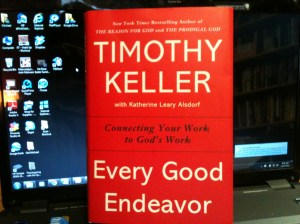
every-good-endeavor-picRedeemer Presbyterian NYC’s famous pastor, Tim Keller, has blogged a reflection on his new co-authored volume (with Redeemer Pres’s Faith and Work Center’s founder and former Silicon Valley executive Katherine Leary Alsdorf), Every Good Endeavor: Connecting Your Work to God’s Work. People have been glancing at the book’s subtitle, says Keller, and asking: “OK, so, in a nutshell, how does God’s work connect to our work?” He answers in four pithy points, which I summarize as a list here. To see what Keller does with each point, check out the full post here.

Here are Keller’s four ways God connects with our work: Continue reading

Pietism, Calvinism, and vocation – reflections from Bethel’s Chris Gehrz


Chris GehrzPlease, talk among yourselves as we at Bethel University engage in a little love-fest.

My colleague in the College of Arts and Sciences, historian Chris Gehrz, always provides lively insights on his Pietist Schoolman blog. Today, triggered by my post here on the divine value of secular vocation, Chris said some nice things about me on that blog. Then he mused a bit on Pietist (lack of?) contribution to thought about vocation, and some of his favorite sources on the same topic, which happen to be Reformed.

I’m skipping the encomiums (but thanks, Chris!) and moving to the latter part of his post:

Where I talk with students about vocation, I have to admit that I’m drawing chiefly on the Reformed tradition: from the section of John Calvin’s Institutes (on being faithful to one’s divine calling) that is my favorite thing to teach to the first-year students in our Christianity and Western Culture course to theFrederick Buechner sermon on calling that I discuss with our department’s seniors at the end of their capstone seminar. It’s no surprise that, when I started talking about vocation in my initial tenure interview, our then-provost (now-president) chuckled, “For a Pietist, you sure sound like a Calvinist.” Continue reading

What Would Jesus Do? He’d fund a tech startup!


English: Looking south from Top of the Rock, N...

Looking south from Top of the Rock, New York City (Photo credit: Wikipedia)

Here’s a fascinating article on a Manhattan network that funds Christian-owned startup companies. And not surprisingly (to me), Tim Keller’s Redeemer Presbyterian Church is involved, providing seed funding to a bunch of startups already.

A couple of snippets, then the link:

The scene at the Faith and Tech meetup group is part of a small subculture of the tech world that supports Christian entrepreneurs. In contrast to the hard-partying, get-rich-fast lifestyle portrayed in a new Bravo reality show on Silicon Valley, these entrepreneurs and investors not only pray together, but also give financial support to faith-based startups and discuss how to build religious companies that are both financially successful and socially responsible.

. . .

In New York City, Redeemer Presbyterian Church has funded 20 startups over the past seven years as part of its annual small business competition. The church sees its investments as an outgrowth of its mission to serve the city, said Calvin Chin, director of entrepreneurship initiatives at Redeemer. To enter the competition, the business founder must be Christian — a rule meant to ensure that each startup operates in line with church values, Chin said. Continue reading

What if secular workplaces ARE an arena of God’s purpose?


This group of folks working together reminds me of the many working people surrounding Jesus–and he didn’t ask all of them to leave their work . . .

Since over a year ago, when a group of us began dreaming and scheming for what has now become the fully-funded “Work with Purpose initiative” at Bethel Seminary, I’ve been thinking a lot about the meaning of work. Or, I should say, meanings. Work often creates economic value. It usually serves other people. It can be an arena of fullest self-expression and self-realization as we exercise our particular gifts and personalities. It can be a place of sanctification, of discipleship, as we struggle through the mundane challenges and difficult relationships that mark most workplaces.

But does it have divine meaning, our work? Is such ultimate meaning of our work reserved for pastors, priests, or monastics? Does God ordain and care for our particular work, even if we don’t wear a collar, alb, or habit?

Related to this question, I’m busy right now writing an article on Christians’ understandings of the concept of vocation or calling through the ages. Here’s some reflection that may or may not make it into the final draft:

These days I’m asking pastors this question: “Do you see it as part of your calling to affirm the divine significance your people’s work in their jobs, in all economic spheres—business, non-profit, home?” Few answer affirmatively, and that’s worrisome. Especially in these recessionary times, much tempts American workers to discouragement: we work more hours, for less pay, with less security, less loyalty to our employers, less sense of our work truly mattering. Most of us want to find meaning in our work. But the church has at times behaved as if full-time ordained ministry is the only arena in which people are really working for God.

Many sincere Christians conclude that the only legitimate arena of vocational meaning is the church. In their first history class of each new year at Bethel Seminary, when I have my students share about their sense of calling, many tell the same story. It boils down to: “I quit my job to go into the ministry.” Continue reading

Steve Garber on Dorothy Sayers’s prescient call to reassess our society’s attitudes toward work


I appreciate a man who not only is a fan of Dorothy Sayers’s essays on work, but also read all the Lord Peter Wimsey novels with his wife during their first year of marriage. This is Steve Garber, of the Washington Institute for Faith, Vocation, and Culture, blogging on the institute’s website:

As we talked, my friend the businessman-become-farmer asked me if I had ever read Why Work? by Dorothy Sayers. I have, and think it is as a good a statement about work as anyone has written. And I smiled, telling him that Meg and I had read aloud all her Lord Peter Wimsey novels the first year we were married. She is a favorite for many reasons.

The following is a short bit from her work on work, Continue reading