Category Archives: Medieval Wisdom for Modern Protestants

CS Lewis, GK Chesterton, JRR Tolkien, and Dorothy Sayers thought medieval faith provides antidotes to modern malaises. So do I.

Introducing Medieval Wisdom: An Exploration with C S Lewis – part 9: Immediatism’s problem with the biblical canon and the Trinity(!)


None of this proves that evangelical immediatism is wrong. But there is another problem with our immediatism: it implicates us in real difficulties about some of the traditions evangelicals ourselves hold dear.

First, immediatism finds indigestible the real story—Lewis would have called it the mere Christian understanding—of how the Bible became a canon of texts that communicates to us the self-revelation of God. The problem immediatism has with the historical Christian understanding of canonical revelation is one, we might say, of process. As is quite easy to verify from the historical sources, that canon comes down the ages to us today not by being dropped, wholesale and intact, from heaven to earth, but through an extended, circuitous communal process. That is, through human mediation. Continue reading

Introducing Medieval Wisdom: An Exploration with C S Lewis – part 8: What historical Christian immediatism got right – and how we’ve gotten off course


https://i0.wp.com/dbcfaa79b34c8f5dfffa-7d3a62c63519b1618047ef2108473a39.r81.cf2.rackcdn.com/wp-content/uploads/Ecstasy-of-Paul-Poussin.jpg

Paul’s Ascent to the Third Heaven by Nicolas Poussin


Where the immediatists are right

At the risk of seeming contrary, I should admit that I have some sympathy for the anti-Catholic Reformers, Puritans and frontier American evangelicals who turned their backs on old forms in search of the face of God. Their fear of elite religious control was born out of European and Protestant history. People in search of power, as some in the church hierarchy had been during the late medieval period, can easily exert its desired control through the forms of church life. Who can say that those democratizing evangelicals didn’t see real abuses in the intellectual elites of their day, as their Augustinian strain of piety melded with a free-range populism and a yearning to be free from the yoke of an “educated ministry”?

Who can say that the gatekeepers of tradition today are themselves immune to abusing their power? And what may be lost when the elites take over and control the very means of grace is just this: immediate access to God in Christ by his Holy Spirit. Under the abuse of power, form becomes formalism, and tradition, “the living faith of the dead,” is replaced (again, as Jaroslav Pelikan lamented) by traditionalism, “the dead faith of the living.” Whatever healthy ressourcement means, it cannot mean a return to the Babylonian captivity of the church.

On the positive side of the ledger, evangelicalism’s single-minded immediatism has protected and promoted a powerful relational, emotional piety; a deep commitment to the practical injunctions of the gospel; a lively expectation of the return of Christ; a passion for evangelism and missions; a legacy of thoroughgoing social reform; and long practice in concerted, ecumenical effort. Any evangelical ressourcement must proceed without damaging these. Continue reading

Introducing Medieval Wisdom: An Exploration with C S Lewis – part 7: Impediments to ressourcement


Prostrate prayerThe impact of immediatism on reclaiming past wisdom

Let’s pause to take an example of how these immediatist values have already prevented the contemporary church from accessing the wisdom of the past. In recent interviews with Richard Foster, Dallas Willard, and others involved, in the last few decades, in trying to woo modern Christians to ancient disciplines and understandings, I heard the same refrain repeatedly: that “spiritual disciplines” movement seems to have stalled out. Why?

A few reasons.

First, discipline requires, by definition, submission. Still marked by the antitraditionalism and pragmatism of their fundamentalist roots, evangelicals seem by and large unwilling to submit their spiritual growth to anything that looks like a mediating practice or tradition. True, many evangelicals have been opened to the riches of Christian spiritual tradition, but like their ecclesiology, these experiments seem to have been mostly an ad-hoc adjunct to the central experience with God.[1]

As an example, in his many books on worship, Robert Webber offered evangelicals a way to incorporate the liturgies of the historic Church through a simple order: The Gathering, the Word, the Table, and the Dismissal. He also recommended a restored commitment to the sacraments, especially the Eucharist, as part of the weekly worship event. Such liturgical borrowings open up a greater role in worship for ritual gesture, symbol, and visual art, which point (as they always have) to spiritual realities beyond themselves. They allow evangelicals to “capture the mystery and transcendence of God in a way that modern forms of Protestant worship do not” and, by reentering historic practices, to stress the unity of the church.[2] But they also require liturgical leadership – what looks suspiciously like sacerdotal mediation. And they tend to require material mediation – which looks like sacramentalism. Continue reading

Introducing Medieval Wisdom: An Exploration with C S Lewis – part 6: Immediatism, the “Bebbington quadrilateral,” and the hole in the evangelical donut


Donut_2Reversing the historical flow – not an easy task

What we are doing in stepping back into the Middle Ages with Lewis’s guidance is attempting to challenge that “line of immediatism” in two ways:

First, from the 17th c. to today, the primary religious authority of scripture/tradition has increasingly given way to that of reason/experience. To desire to learn from the cloud of witnesses or “church triumphant” – those one whose shoulders we stand – is to shift authority back to the older style, weighting Scripture-read-through-tradition more heavily than the dictates of individual reason and experience.

Second, from the 17th c to today, the primary way individuals have met God has shifted from a church-mediated to an individual, unmediated mode. Any full and useful appropriation of the pastthat is, one not content just to offer doctrinal direction—will likely seek to return to some form of churchly mediation, whether of liturgical forms, priestly role, or both, attempting to reverse this post-Enlightenment trajectory.

Look, feel, and results of immediatism

What, then, does immediatism look like in evangelical churches today, and how does that degrade our ability to gain benefit from the church of the past? Continue reading

Introducing Medieval Wisdom: An Exploration with C S Lewis – part 5: Immediatism in evangelicals’ “mother’s milk”


campmeeting_color-1024x778Immediatism vs mediation

We find immediatism in my fourth sense—the belief that the average layperson has direct, individual access to God, with no other mediator beside Christ—at evangelicalism’s Protestant roots. Since the Reformation, Protestants have distrusted tradition as potentially leading people back into what Martin Luther had called the “Babylonian Captivity of the Church.” Luther and the other Reformers sought to strip away a mass of rituals and requirements that had accumulated during Christianity’s thousand-year “middle age,” as they imagined, like malignant barnacles on the ship of the church. These traditions, it seemed to them, now obscured the central truth of salvation by grace through faith—God reaching directly to the believer and achieving the work of salvation without human effort.

An irony here is that the theologian who loomed over the whole medieval period, on whose thinking, as Jaroslav Pelikan has said, all of medieval theology served as something like a set of footnotes – Augustine of Hippo – had taught unequivocally that salvation can come to us by no other means than God’s unaided grace. This was still the official teaching “on the books” of the medieval church right up until the Reformation—though a group of “modern” theologians, to whom Luther was reacting, were trying to import categories of human effort into the picture of how salvation takes place. Augustine, however, had been wise enough to see that the individual believer cannot come to faith outside the community of the church. And he had been willing to make some quite strong claims for the role of the church in salvation. The Reformation may even be considered, as some have said, “the triumph of Augustine’s soteriology (his understanding of salvation) against Augustine’s ecclesiology (his understanding of the church). Those Protestants, however, who believe that the whole Western medieval church believed in “salvation by works” are following a long tradition of Protestant insult-hurling that ignores much medieval evidence to the contrary!

Luther was not yet a thoroughgoing immediatist. Continue reading

Introducing Medieval Wisdom: An Exploration with C S Lewis – part 4: Immediatism


OXYGEN Volume 09Immediatism

To begin to understand the barrier that stands between us and medieval wisdom, consider this vignette: a snapshot from the period that defined American evangelicalism more than any other: the Victorian era.

In 1850, Methodist laywoman Phoebe Worrall Palmer published a book called The Way of Holiness. In it, she said this about the traditional Methodist teaching of sanctification: “Yes, brother, THERE IS A SHORTER WAY! O! I am sure this long waiting and struggling with the powers of darkness is not necessary. There is a shorter way.”

These would turn out to be momentous words for nineteenth-century American evangelicals. Already by that year a flood of church leaders, including several Methodist bishops, had for over a decade been visiting Palmer’s New York City parlor to attend her “Tuesday meetings for the promotion of holiness.” And within a decade more, her “holiness movement” would jump denominational lines, initiating Presbyterians, Quakers, Baptists, and Episcopalians into this optimistic creed.

The essence of Palmer’s message was this: No more would Christians have to pursue the fraught and painstaking path to sanctification taught by John Wesley (reminiscent of the slow and agonizing path to conversion once trod by English and American Puritans who had influenced Wesley). Now by simply gathering their resolve, making a single act of consecration, and “standing on the promises”—certain Scripture texts that seemed to hold out entire sanctification as an attainable reality—they could enjoy total freedom from sin.

This message galvanized a generation and set a tone for evangelicalism that continues to ring out today. It may be fair to say that the teaching of a “shorter way to holiness,” whether in Palmer’s more Wesleyan formulation or in the Reformed-influenced “higher life” variations introduced later in the century, was the single most prominent and widespread movement among postbellum and Gilded Age evangelicals. It swept across the nation’s West and South like a sanctified brushfire, birthed new denominations such as the Nazarenes and Christian Missionary Alliance, fed the all-consuming fervor of temperance activism, and laid the groundwork for the Pentecostal movement of the following century.

Why? What made Palmer’s “shorter way” such a natural fit for evangelicals in their century of growth and social prominence? And what does this have to do with the project to recover past wisdom in the church? Continue reading

Introducing Medieval Wisdom: An Exploration with C S Lewis – part 3


broken-churchState of the church today

The American church today is in turmoil. We have tried, by turns, rational apologetic, pop-culture inflected consumerist church programs, ecstatic charismatic experience, and postmodern experimentation. None of these has proved lasting.

The rationalism of modern apologetics has collapsed as the questions of the unchurched have turned away from doctrine and the agonies of the churched have centered on spirituality and practice rather than belief.

The beguiling concerts and spectacles of the church growth technicians have fallen short of their promise, revealing the dismally shallow spirituality behind the curtain.[1]

The experientialism of the charismatic movement has faltered in the quest to build lasting, faithful, discipled churches as worshippers have bounced from one high to the next.

The postmodernism of some “emerging” Christians has not yet found a positive program for reform to go with its often strident critique of current church culture. Continue reading

Introducing Medieval Wisdom: An Exploration with C S Lewis – part 2


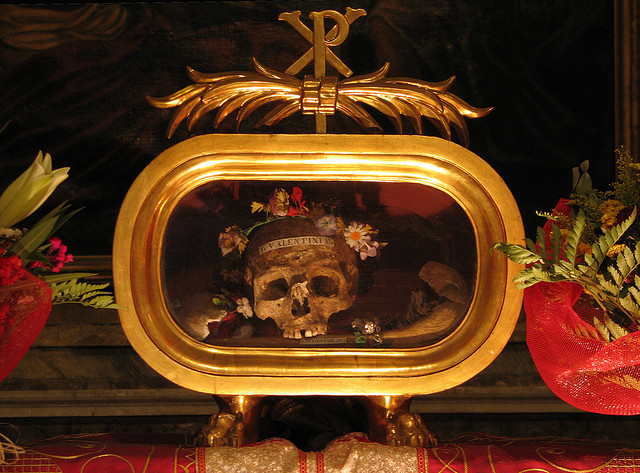
St Valentine's relicsThe alienness of it all – and, on not being an antiquarian

I don’t deny that the terrain of the medieval church seems alien to most of us today. Before us, relics peer out from within gilded boxes, and the devout approach them as conduits to divine power. Above us, saints hover supernaturally, and the earthbound plead for their intercession. At the high altar, the priest, back to congregation, performs an elaborate sacred drama, elevating the bread and wine, pronouncing the Words of Institution, and the devout await the ringing of the bell, at which time they gaze at those same elements and see the literal body and blood of Christ. Within the confessional, the penitent kneels, receives absolution, and hears the works of satisfaction she must perform for her soul’s sake. And in cloisters, cathedrals, and cow pastures, tonsured monks sing Psalms, mitered bishops pronounce on doctrine, and ragged peasants supplicate Mary with weeping.

It seems to me, however, that the chasm between us and our medieval forefathers and -mothers in the faith has less to do with any intrinsic oddness about the Christians of that time, and more with certain philosophical and cultural presuppositions of our own. So, though may seem odd for a book about “medieval wisdom” to start with an assessment of the church today, this one is about to do that, for two reasons: Continue reading

Introducing Medieval Wisdom: An Exploration with C S Lewis – part 1


6140889513_17be7558ec_b


Well, after a job loss (last November) and a job search, since July of this year (2014) I am Director of Opus: The Art of Work – an institute at Wheaton College, Wheaton IL, dedicated to understanding God’s call for our work in the world.

All of this has delayed my forthcoming Baker Academic book, Getting Medieval: An Exploration with C S Lewis. But at last, the manuscript is in (yes, that’s me in the photograph, working in appropriately medieval style) and the editorial wheels are turning. Look for the book early in 2016!

Last-minute editing included a complete overhaul of my introductory chapter. So I’ll be posting the revised introduction bit by bit over the next few days. It includes what I think is a significant argument (based in a scholarly analysis of American Christian history – my specialist field) about why many of today’s American Christians dismiss 1,000 years of Christian history as irrelevant or at best a long string of dismal negative examples of how not to be a Christian. And it includes a taster of the nourishing themes I’ve found in my own study of medieval faith.

So, here’s the first bit of the revised introduction: Continue reading

Holy Roman Emperor, Batman! A great opportunity to get on board with Christian History magazine


CHM108_EmailHeader_C

Friends, if you haven’t yet pulled the trigger on a free-with-encouragement-to-donate subscription to Christian History Magazine, now’s the time! Trust me, this upcoming Charlemagne/Christendom issue is both fascinating and gorgeous. Man, am I proud of the jobJennifer Woodruff TaitEdwin Woodruff TaitDawn Myers-MooreJennifer Trafton PetersonMeg Goddard Moss, and the rest of the Christian History team have done on this one. Sign up right away and you’ll soon be getting this in the mail.

Here’s the link with the skinny.