Is work irredeemably secular? – part IV


Continued from part III

The Methodist story gives us a vision for responsible work and broad social action, but we may still wonder today—and this is our third question—(3) how we can work faithfully while also while actively pushing back against those parts of our organizations and sectors that are unjust, or immoral—that is, that harm rather than hurt people? Where are the Christian resources that can help us act redemptively within unredeemed systems?

One Christian leader who armed others for such redemptive action was the late-Victorian American Congregational pastor Charles Sheldon.

It’s a Sunday morning near the end of the 1800s, in the comfortable upper-middle-class “First Church” in the town of Raymond, somewhere in the Midwest. Halfway through the service, a tired, sick homeless man walks into the church, up the aisle to the front, and begins to speak. He wonders aloud why there is so much trouble and misery in the cities when their well-off Christians sing so much about consecrating themselves entirely to God. “It seems to me,” he says, “there’s an awful lot of trouble in the world that somehow wouldn’t exist if all the people who sing such songs went and lived them out. I suppose I don’t understand.” Then he asks, in that now-familiar phrase: “But what would Jesus do?’”

Continue reading

Is work irredeemably secular? – part III


2012 London Olympics final rehearsal, “Pandemonium” section, by Matt Lancashire (Wikipedia, Creative Commons license)

Part II of this series ended with this statement:

So our first question—does time dedicated to working in the secular world endanger our souls?—is answered by Gregory like this: the active life of service may serve as handmaiden to the contemplative life – and the contemplative to the active, in return.

Sadly, medievals did not always remember this insight, tending to return to the old elevation of the monastic life above the ordinary life. This was one reason Martin Luther found himself, in the 16th century, needing to recover the God-givenness of bakers baking and tailors sewing and fathers changing their infants’ diapers.

On Luther, more later. But now another challenging question arises in our complex, post-Christian workplaces full of real, fallen people:

2. Does practicing the virtues demanded by the working life (such as industriousness, self-control, service to others, obedience to rules and leaders) reduce us to drones or pawns in exploitive structures of modern work? Or, Does becoming a good Christian worker mean sacrificing social conscience for placid obedience—prophetic witness for financial security?

To help us answer this, we turn to our second past leader, England’s 18th-century evangelical pioneer, John Wesley.

Anyone remember the opening ceremony of the 2012 London Olympics? As the spectacle started, before millions of worldwide viewers, England’s pastoral island paradise rose slowly into view from below ground, to the wafting strains of British composer Edward Elgar.

But then – suddenly – the paradise was shattered. 

Continue reading

Is work irredeemably secular? – part II


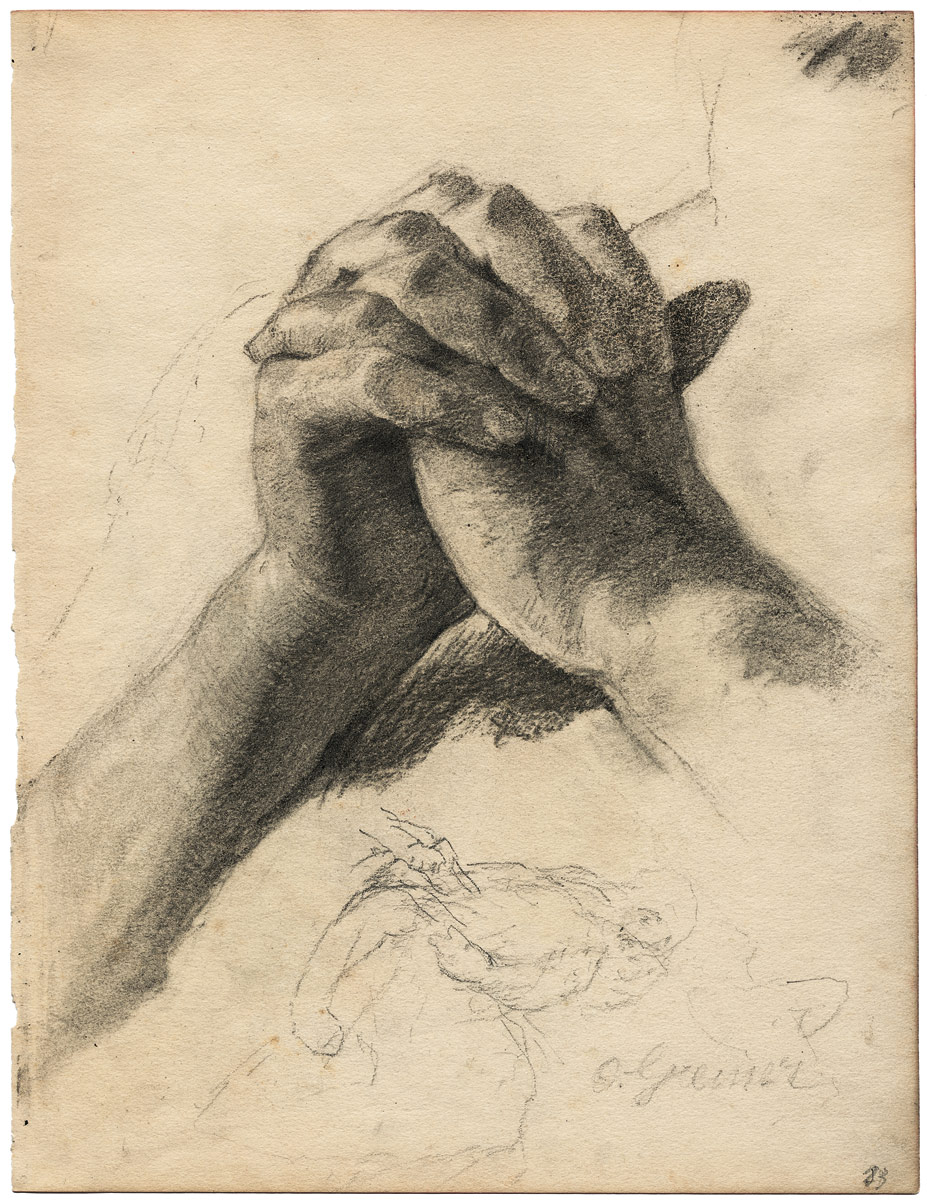
Otto Greiner, “Betende Hande”

Continued from part I

Let’s jump right in. I’m going to frame each of these four issues in the form of a question that may stand between us and a sense of Christian vocation in our work.

Here’s the first question that may be nagging us as we seek a sense of vocation in our work:

  1. Does time dedicated to working in the secular world endanger our souls? Is there an inherent tension or contradiction between the “worldliness” of work and the “spirituality” of faith?

A century or two before the opening of the Middle Ages, the theologian whose influence would become definitive for the next thousand years, Augustine of Hippo, distinguished two spheres of human endeavor: the “active life”—our work in the world—and the “contemplative life”—our private worship and prayer. The active life could be good, but the contemplative life, such as that enjoyed by monks and nuns, was much better—and indeed safer for our souls.

Augustine’s bifurcated view of work has persisted in some circles right up to this day – but it was quickly challenged by the man some consider the spiritual father of the medieval church, as Augustine was its theological father.

Continue reading

Is work irredeemably secular? – part I


Cathedral of St Stephen, Brisbane; wikimedia (creative commons)

A couple of years back, in the depths of the COVID pandemic, I was invited by Sioux Falls Seminary to address an international group of their students via Zoom on a topic related to faith and work. Reflecting on the assignment, and aware that I would be addressing workplace Christians studying for ministry in one of the most innovative seminaries in the world (which has now spread globally and renamed itself Kairos University), I decided to address the “sacred-secular divide” that many experience acutely in their working lives. The resulting talk draws on four historical figures who addressed this divide in various ways. Here it is, in five parts:

This past January, I was co-teaching a group of graduate students at Regent College, in Vancouver, BC, with that wise and humane thinker on faith and vocation, my friend Steve Garber. Steve had asked me to join with him in creating and teaching a course for Regent called “Models of Public Engagement.” My contribution was to provide readings, mini-lectures, and discussion prompts from a wide variety of historical people of Christian faith. By the class’s second day together, in our Vancouver intensive week during which it would snow, rain, and blow gusts of freezing wind every day, it had already become a class joke that all of Dr. Armstrong’s best friends are dead.

This is actually not far off the mark. You can find my blog-site, for example, at “gratefultothedead.com.” (This, by the way, has confused more than a few Grateful Dead fans, who have wandered onto the blog expecting to find me writing about Jerry Garcia.)

But I can’t help myself. I love introducing people to my friends. As a wise priest once said to me, the teaching gifts of our past leaders have a very long shelf life. Yes, and I’d add, their lives as well as their teachings can also still speak to us today. So this afternoon as we dive into a few questions about how to find Christian vocation in a working world where Christ is so rarely named, I’ll be sharing with you from the thought and lives of four of my best dead friends. These are Gregory the Great, John Wesley, Charles Sheldon, and C. S. Lewis.

Continue reading

A few more accessible, fully illustrated, scholar-written resources on faith and science!


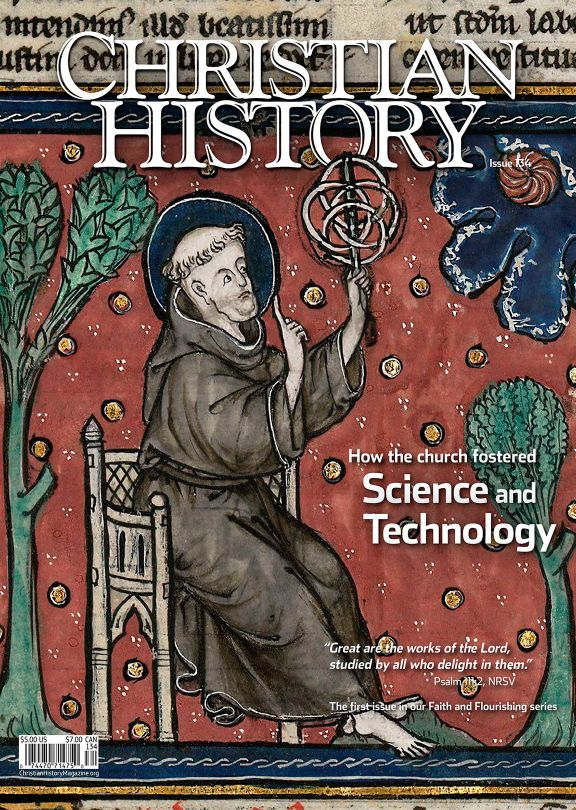
Issue 134, 2020

For those who enjoyed my faith & science history series over the past couple of weeks, there’s a treasure trove awaiting: The recent Christian History issue(s) on the same topic. You can browse the issue in full color and download pdfs of individual articles here.

Which reminds me to say . . .

. . . if I had a nickel for every time someone has said they didn’t know that Christian History had re-started after its then 26-year run ended in the fateful year 2008 . . . well, I’d be able to buy a fancy coffee or two. And little did anyone know – leastwise the magazine’s editors and parent (non-profit) organization – that in 2022 we’d be cruising into CH’s 40th anniversary year (special anniversary issue coming – keep an eye out at this link!).

But since 2011, the magazine has indeed lived again – and what a run it’s been, under the indefatigable editorial leadership of scholar/editor/writer/priest extraordinaire Jennifer Woodruff Tait. Among the topics we’ve covered just in the past few years: America’s love affair with the Bible; CS Lewis’s friends & family and their influence on him; Christian support for the common good in science, healthcare, higher education, the public square, and the marketplace; Christianity and Judaism; plagues and epidemics; Latin American Christianity; the women of the Reformation; the Quakers . . .

And for those interested in topics churchly/scientific, check out the following issues:

Hard to believe that last one, my very first issue as (short-lived) managing editor, came out a full 20 years ago! And I’m still proud of it . . .

Thanks y’all for reading my blog. I hope you enjoy these resources!

Christian foundations of science and technology innovation, part VII (final)


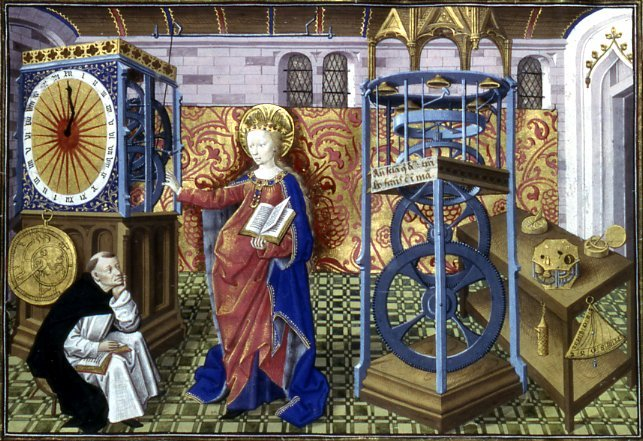
Miniature from 1450 taken from a copy of “Horologium Sapientiae” written around 1330 by Constance Henrich Seuse, Bibliothèque Royale Albert 1er, Bruxelles

. . . continued (and completed) from part VI

But though intellectual curiosity or the expectation of a lawfulness in nature mirroring the rationality of God did help drive the rise of science, it was not the only factor. Another, more practical consideration also contributed, and this brings us to Fact #9. That is, that medieval Christians also saw their rational study of creation as helping fulfil the cultural mandate of Genesis by developing new tools for better living.

In other words, the pursuit of scientific knowledge was already, even among the medieval scholastics, a matter not just for speculative or devotional interest, but also a way of contributing to human flourishing. The scholastics understood that God wants us to live in full enjoyment of his creation as well as his fellowship. God will not allow this full enjoyment and flourishing to be completely destroyed by the disobedience of humans in the fall, and so he works with and through human reason to improve every area of human life through new technologies, advances in medicine, and every other field of material culture.

Thus medieval theological education fostered every science and art—the quadrivium of the maths and sciences (arithmetic, geometry, music, astronomy) as well as the trivium of the humanities (grammar, logic, rhetoric). Though theology remained the “queen of the sciences,” every medieval university student, in order to earn a bachelor’s degree, had to study arithmetic, geometry, and astronomy as well.

Continue reading

Christian foundations of science and technology innovation, part VI


William Blake, The Ancient of Days setting a Compass to the Earth, frontispiece to copy K of the artist’s Europe a Prophecy

. . . continued from part V

As they sorted and tidied, the university-based natural philosophers began discovering that nature often contained its own causal explanations, which could be identified through observation and experiment. In the heyday of the scholastics, Thomas Aquinas’s teacher Albertus Magnus, for example, wrote two scientific treatises that helped to found empiricism and the scientific method—one on botany and one on zoology—and sought empirical knowledge everywhere he went through observation and experiment. “[Albert] used his journeys through the Western world to further this interest, and was forever asking questions of fishermen, hunters, beekeepers, and bird-catchers.”

Such thinkers certainly did not intend to deny God’s creative, providential activity—just to highlight the more and more evident fact that nature operates according to its own mechanisms, which are describable in naturalistic terms.

By the early 14th century, those terms were becoming increasingly mathematical. Scholars of that day such as Thomas Bradwardine at Oxford (later to become Archbishop of Canterbury) used mathematical theory to challenge and update old, incorrect scientific beliefs inherited from Aristotle. The new and more accurate groundwork they provided on a variety of scientific questions prepared the way for the work of Sir Isaac Newton (1642-1717) and other stars of the scientific revolution.

Lest we think, though, that as math entered, faith exited (as some have interpreted Newton’s work!), it is important to see how our eighth fact, the harmonization of scientific and theological understandings, was already emerging in the time of the scholastics.

Continue reading

Christian foundations of science and technology innovation, part V


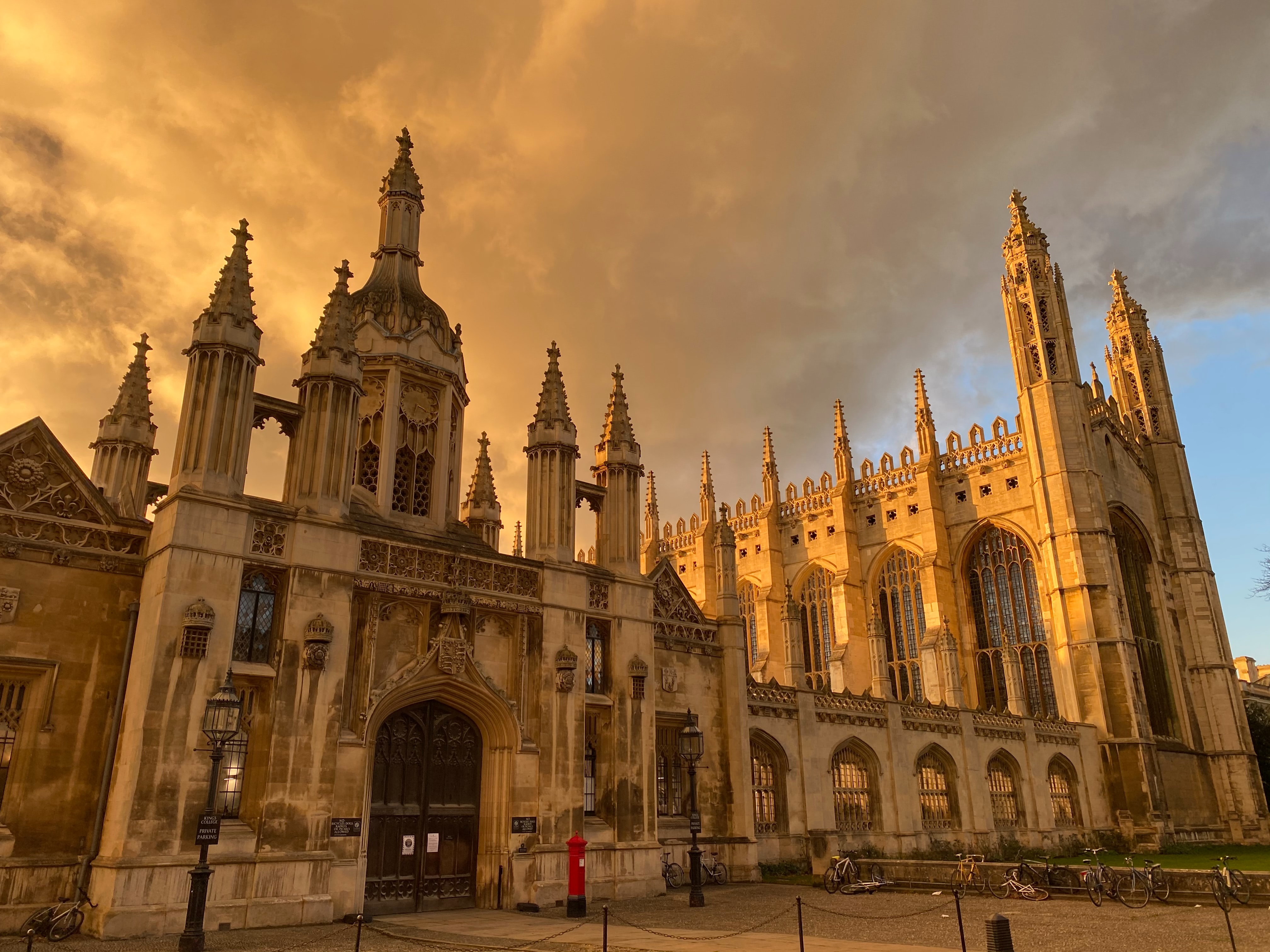
Gatehouse and chapel of King’s College, University of Cambridge; Photo by Tim Alex on Unsplash

. . . continued from part IV

Sacramentalism provided the seedbed for the pursuit of scientific knowledge, especially in the high-medieval period of the birth of the universities (from the 11th to the 14th centuries). In part, it did this by birthing – and this is our fifth fact – a truly devotional, awe-filled approach to that pursuit.

Think about it: when we may look at the natural world not only as the arena of God’s work but as a physical reality that reflects his divine glory, then how else would we approach it but with awe and wonder? And since medieval and early modern followers of Christ indeed believed this, they approached their study of the world not only out of a duty to apply the gift of reason, but also out of a sense of awe that the world is a conduit to God’s presence and glory. Should it surprise us, then, that the natural philosophers of that age spent hours and days and years of their lives in meticulous proto-scientific experimentation and hypothesizing?

Continue reading

Christian foundations of science and technology innovation, part IV


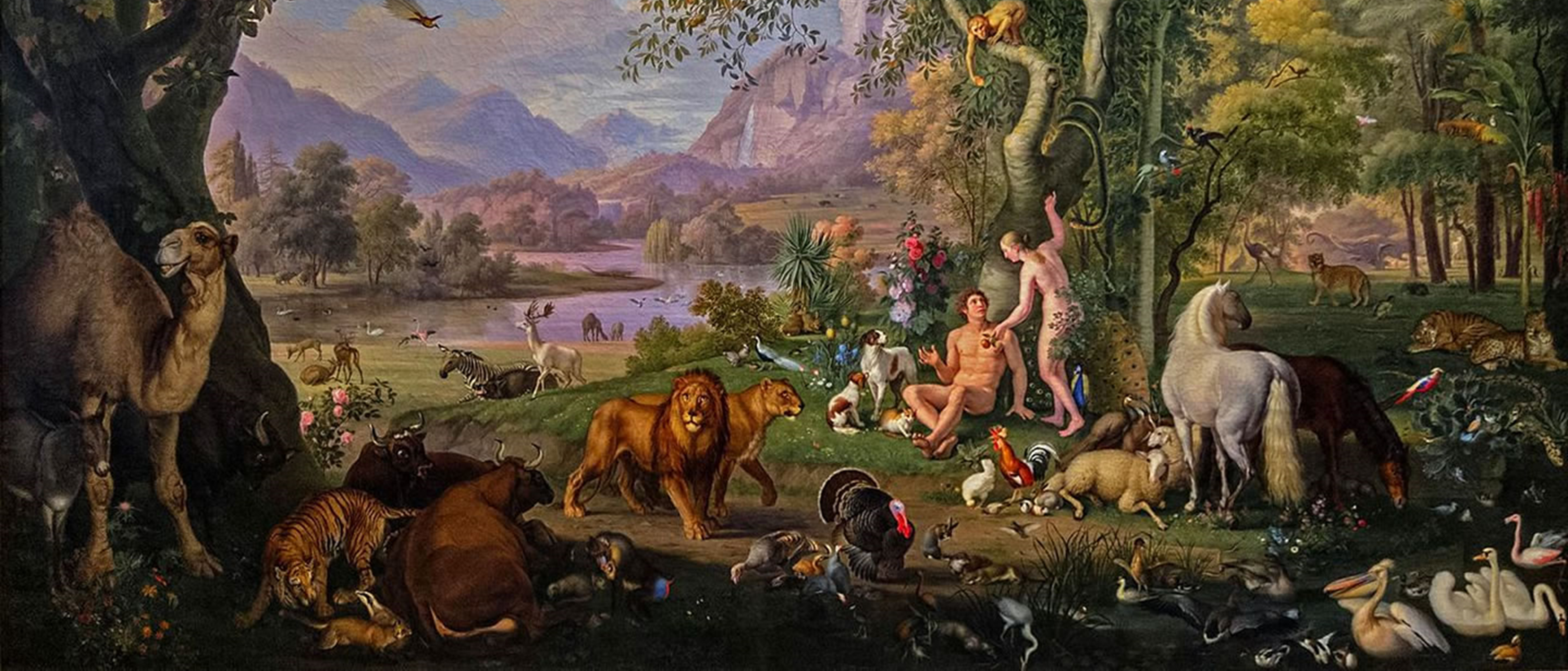
Johann Wenzel Peter (1745-1829), Adam and Eve in the earthly paradise, Wikimedia Commons

. . . continued from part III

But there is more: A third foundational fact in the Christian development of science and technologies was that the early and medieval Christians understood that God intended they apply the gift of reason to understanding and ordering the gift of Creation—for our flourishing. They saw this important role of reason in the cultural mandate already in Genesis—for example, in the task assigned to Adam and Eve of naming the animals, or God’s charge to them to cultivate and keep the garden.

That the medieval church was not afraid to exercise this mandate of applying reason to the world is illustrated in the story of the man who became pope just before the turn of the millennium – in 999 AD. Of humble origins, Gerbert of Aurillac – who was perhaps relieved to be able take the papal name Sylvester – had developed through talent and education into Christendom’s foremost mathematician. A teacher of arithmetic, astronomy, and harmonics, Gerbert’s knowledge in these fields was admittedly hampered by his inability to read Greek—and therefore to read the best of the ancient pioneers of those fields. But his career showed that even in those so-called “dark ages,” the study of natural philosophy (what we have called “science” only since 1834) was no impediment to a highly successful career in the church. And why should it be? For early and medieval Christians adapted that field of study, “natural philosophy,” from the Greek philosophers, only now understanding it as the study of God’s wisdom as reflected in his creation.

In fact, a couple of hundred years after Gerbert, another Christian scholar, Hugh of St. Victor, described the natural world as a book written by God’s finger – and therefore just as appropriate for Christians to study as the Bible.

For medieval natural philosophy to develop into science as we know it today, however, it needed two more understandings.

Continue reading

Christian foundations of science and technology innovation, part III


Justin Martyr (Wikipedia)

. . . continued from part II

2.   Reason is a gift too, and an important part of God’s image in us

A second important fact for the historical Christian engagement in scientific and technological pursuits is that from the earliest years, Christians have understood human reason as a second gift, along with creation. This positive understanding of reason flourished, again, from the earliest years of the church. As historian Jaroslav Pelikan puts it, “When the Christian gospel came into the world, it succeeded in converting the most rational of men, the Greek philosophers, to its message; this was proof that the gospel was not to be dismissed as irrationality and ‘insanity.’”

Among those converted philosophers were such key early Christian leaders as Athenagoras of Athens, Justin Martyr, and Clement and Origen of Alexandria. Such thinkers continued to function as philosophical teachers, and in that role, they forged systematic Christian understandings of God, humanity, and the world – a tradition of Christian thought that has continued to today.

Now you may suspect that when I say this tradition of careful Christian thought about things “continued to today,” I’m passing too lightly over the medieval Church critiqued by Condorcet. Wasn’t that Enlightenment skeptic right? Weren’t medieval people ignorant haters of knowledge who were sitting around waiting for the Enlightenment to happen so they could finally crawl out of the darkness and into the clear light of reason? That is what we so often hear.

Continue reading