Tag Archives: Creation

Where have all the artists gone? Protestant suspicion – and Catholic celebration – of the arts


English: Madonna and child, thought to have be...

English: Madonna and child, thought to have been damaged during the English Civil War, at St Mary’s Roman Catholic church, Brewood, Staffordshire, England. (Photo credit: Wikipedia)

In the “creation chapter” of my forthcoming Getting Medieval with C. S. Lewis, after a brief reflection on the opposite-but-the-same Western tendencies that have crept into our Protestant churches – Gnosticism and materialism – I turn to the arts to see how these tendencies have manifested themselves there.

Evangelicalism and the arts

Let’s put a finer point on the issue by looking briefly at the evangelical Protestant churches and the arts. Where are the arts in modern orthodox Protestantism? One author looks at the century from 1860 to 1960 and finds only C. S. Lewis and T. S. Eliot practicing the creative art of literature to a high degree from an orthodox Protestant stance. During the same period, the Catholics produced an embarrassment of literary riches, from Tolkien and Flannery O’Connor to Gerard Manley Hopkins and Evelyn Waugh. All these, and many other Catholics, were “world-class writers,” and all orthodox Christians. The same seems to be true – perhaps even more so – in other fine arts. Similarly, few evangelicals have excelled in the worlds of television and movies. Indeed, “evangelical Protestants, especially, have not only not shone in the fine arts, they have often opposed such arts or valued them only as vehicles for evangelism, objecting to much of their subject matter.”[1] The author concludes that the problem for Protestants (and the superiority of Roman Catholics) in the arts stems from a difference in approach to Creation. Whereas Protestants often emphasize how fallen Creation and human society are, the theology of the Roman Catholic Church has proved more Creation-positive, and thus more likely to affirm and create images of the world, whether literary or in the visual arts. Continue reading
Gnostic or hedonist – it all amounts to devaluing Creation


beautiful-alley-bench-nature-spain

I think I’m well and truly into the Creation chapter of Getting Medieval with C S Lewis. Hoping to have it finished tonight or tomorrow. As with most of the other chapters, I’m starting with a framing of the modern problem(s) to which medieval faith suggests a solution. In this case, we’re looking at two sub-Christian attitudes to material stuff (including rocks, strawberries, gerbils, our human bodies, and all the ways we make culture in our social interactions). I don’t discuss the “medieval” solution yet – that will come in the next couple of posts.

Our issues: Gnosticism and materialism

Gnosticism

The early Christian Gnostics disavowed the spiritual significance and goodness of the material world: the world was created not by our God, who called his handiwork “good,” but rather by an inferior sub-god called a “demiurge.” Thus one must set aside the material world if one is to reach God. The world cannot be in any way a channel of Grace – it is rather an impediment to grace.

One online author who is convinced he sees Gnosticism all over the modern church suggests the following tests—a sort of “you might be a gnostic if . . .” The signs of gnostic thinking he identifies are (1) thinking Christianity is about “spiritual” things (only), (2) thinking of our destiny only in terms of our souls going off to heaven, (3) forgetting that “Christianity teaches the redemption of all creation (New Creation) and not evacuation from creation (‘the rapture’),” and (4) believing that God neither gives us material things as means of grace, nor indeed cares about the earth at all – and neither should we.

This syndrome of devaluing the material—sapping it of all spiritual significance—supports a number of modern Christian bad habits. One is the sort of “it’s all gonna burn” end-times scenario indulged in the Left Behind novels. Another is the excuse Baby Boomers (and others) make for the fact that their faith makes no difference in their daily life: “I’m ‘spiritual but not religious.’”[1] Continue reading

C S Lewis, G K Chesterton, romanticism, Creation, community, sex – musings on Catholicism and the quiddity of things


Adam and Eve in the garden of Eden, Lucas Cranach the Elder, 1530

Adam and Eve in the garden of Eden, Lucas Cranach the Elder, 1530

Still hammering away at Getting Medieval with C S Lewis. Turning now to the “creation chapter.” Here are a few halting thoughts toward an introduction. They won’t appear in the final book in this form, but they suggest some linkages between medieval Western faith and modern Catholicism – in an area Protestants could learn from:

Modern Catholic tradition still draws from the Creation emphasis in the medieval church, which has attenuated in Protestantism.

Lewis picked this Creation-positive spirituality up too. Think of his love of storms, rocks, trees; his laughing exuberance in storms, rain, fog, drizzle (making him the perfect Englishman), as he reveled in “the quiddity [“that-ness,” essential nature] of things”; his use of long walks in the country to recharge himself.

We might see in these things the influence of the Victorian romanticism still lingering especially in literary and artistic corners of the British Isles during Lewis’s growing-up years: that sense of the mystic sacredness of nature itself, the sort of lavish and sometimes dark and even pagan pantheism that made Blake such an odd duck, led the brilliant Catholic engraver Eric Gill to create his frank and shockingly explicit public works of art, and brought the late-19th-century Decadents such as Aubrey Beardsley and Oscar Wilde (both of whom became Catholic) down into their pit of muck. Continue reading

Our stewardship of creation – a reflection from Laity Renewal’s Mark Roberts


creation of man

Today I want to share a reflection that appears on Laity Renewal’s “The High Calling” site. If you don’t know that site and you are interested in the question of how your work relates to your faith, then you have a treat in store.  You can also sign up on the site to receive these reflections from Mark Roberts every day. I’ve been reading these for a while, and I find this a particularly edifying and inspiring one: Continue reading

Embodiment, emotion, death, asceticism . . . an attempt to describe the legacy of medieval faith


The Book of Kells is one of the most famous ar...

A page from the Book of Kells

The book Medieval Wisdom for Modern Protestants, or as I think of it these days, Getting Medieval: A faithful tour of the Middle Ages with a little help from C S Lewis, is trying to be born, and I’m trying not to get in the way. I’m struggling to express an argument which will set up the medieval centrality of the Incarnation and Creation as that period’s most important legacy to us today.

What follows is just rough-draft wording of a short passage for the book’s introduction. Arguments and details still seem to pull in opposite directions, but I’m convinced of the truth, at least in outline, of what I’m struggling to express here.

Readers, I’d value your thoughts on this brief, rough, passage. Where can I go from here? How can I refine and add power to this argument? What am I missing? Where am I too negative about the modern church? Too positive about the medieval? Does this argument resonate at all with your experience or does it just seem to you to miss the mark?  Continue reading

Dorothy Sayers on “the contemplative vocation of the artist”


Shout out to my all-time favorite female apologist (that is, a person who is female and a Christian apologist)–Dorothy L. Sayers. A neat article today by a smart young fellow I once met at the Marion Wade Center at Wheaton, named Cole Matson. Cole presents one of Sayers’s most powerful ideas: the spiritual as well as intellectual integrity of the artist/writer/dramatist:

For Sayers, the artist is a person who is called to a contemplative vocation, and who delights in sharing the fruits of that contemplation with others through the creation of artworks. Artistic creation is a necessary part of the vocation; a contemplative who is not also a craftsman is not an artist. But contrary to Lewis’ focus on an artwork’s potential value for edification, Sayers focuses on the artist’s inner delight in making as the raison d’être of artistic creation. ‘The only rule I can find,’ Sayers writes, ‘is to write what you feel impelled to write, and let God do what He likes with the stuff’[7].

[SAYERS:] Do you think that love of creation is sufficient reason to justify making art? Or do you think an artist must also consider whether or not his art will edify? If you are an artist, how do you keep yourself open to hear the words or images you may be given?

You can read the whole article here.

CS Lewis’s medieval “world-sacramentalism”


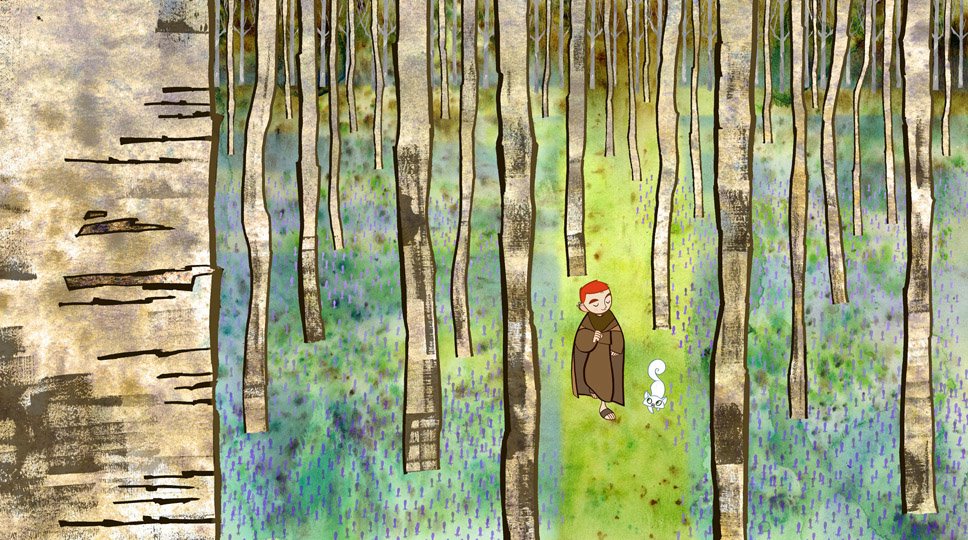
Brendan in the birchwood, from the wonderful animated film The Secret of Kells (note the cross shape of the path!)

Like the medievals, C S Lewis loved created things in a way that amounted to sacramentalism. That is, he saw the created world as a channel of God’s grace–a special means of communications from God to us. Excised from the reading draft of my paper “The Intuitive Medievalism of C S Lewis” (International Medieval Congress 2011) were the following notes on this aspect of Lewis’s “world-sacramentalism”–a topic I did treat in the paper, but only briefly:

From Peter Kreeft, “How to Save Western Civilization: C. S. Lewis as Prophet,” in A Christian for All Christians: Essays in Honour of C. S. Lewis, ed. Andrew Walker and James Patrick (London: Hodder & Stoughton, 1990):

“Lewis describes what a medieval boy learnt in school: ‘farriery, forestry, archery, hawking, sowing, ditching, thatching, brewing, baking, weaving, and practical astronomy. This concrete knowledge, mixed with their law, rhetoric, theology, and mythology, bred an outlook very different from our own. High abstractions and rarified artifices jostled the earthiest particulars . . . They talked more readily than we about large universals such as death, change, fortune, friendship, or salvation; but also about pigs, loaves, boots, and boats. The mind darted more easily to and fro between that mental heaven and earth: the cloud of middle generalizations, hanging between the two, was then much smaller. Hence, as it seems to us, both the naivety and the energy of their writing . . . They talk something like angels and something like sailors and stable-boys; never like civil servants or writers of leading articles.’”[1] (200; N. 29: Lewis, English Literature in the Sixteenth Century, p. 62.)

“We moderns have lost the solid objectivity both of the high universals (especially truth and goodness) and of the low particulars, the concrete world. Both have been dissolved into a vague, abstract, ideological-political-sociological-psychological mid-range. We are the ‘middle’ ages.” (200; N. 29: Lewis, English Literature in the Sixteenth Century, p. 62.)

Lewis’s love of the concrete was sacramentalist: “Every created thing is, in its degree, an image of God, and the ordinate and faithful appreciation of that thing a clue which, truly followed, will lead back to Him.” (Lewis, Commentary on Arthurian Torso by Charles Williams [Oxford: Oxford University Press, 1948], p. 116.) In this, too, he was medieval to the core. Continue reading

Glimpses of what Creation meant to medieval Christians, from Emile Male’s The Gothic Image


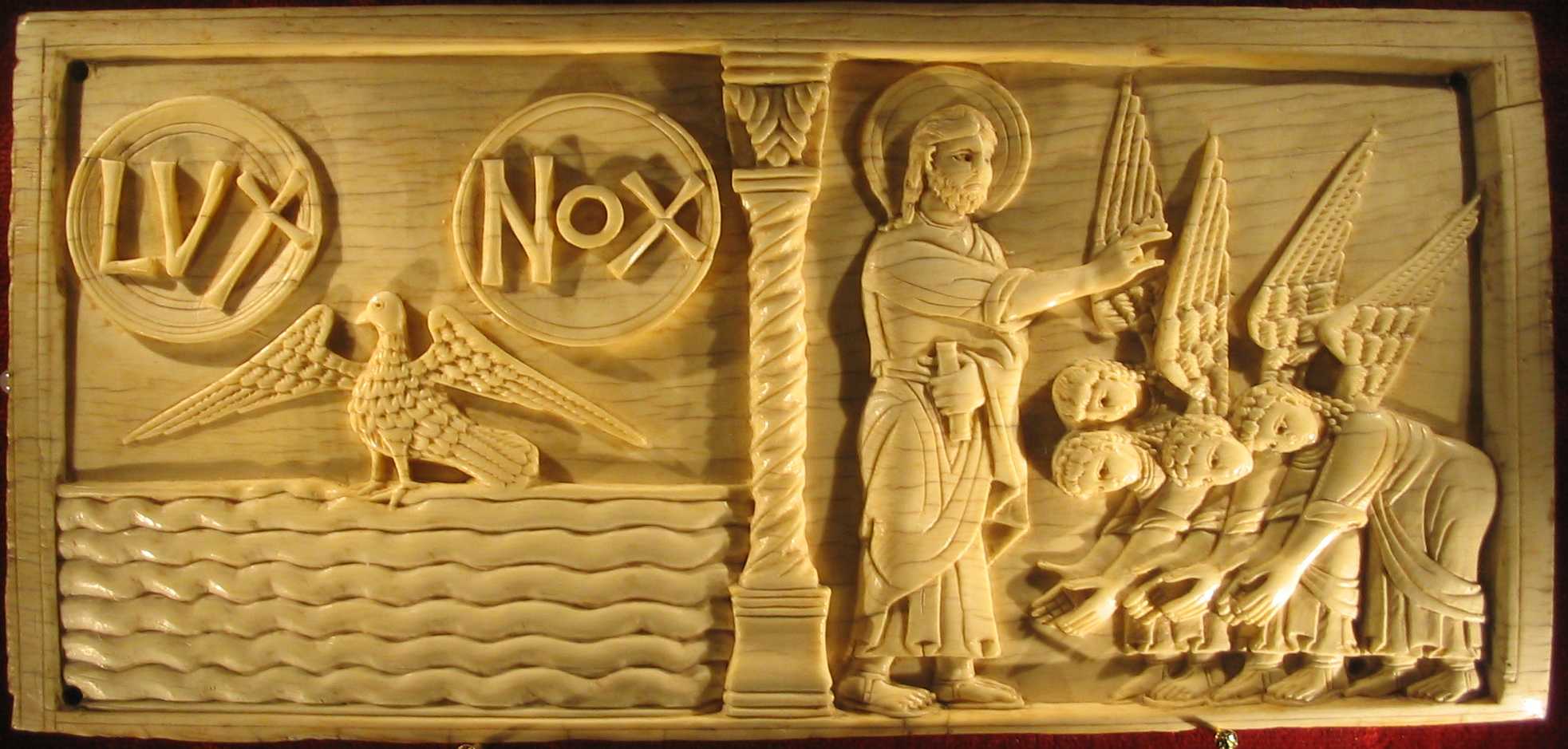
The First day of Creation: ivory panel from the cathedral of Salerno, ca. 1084

Oh, how the medievals loved Creation. C S Lewis once observed, “Marcus Aurelius wished that men would love the universe as a man can love his own city. I believe that something like this was really possible in the [Middle Ages].”

No one saw more clearly the medieval love affair with Creation than the early twentieth-century French medievalist Emile Male.

Way back in the mid-90s, when I was at Gordon-Conwell (and a library rat), I was browsing through a stack of books given to the community by the widow of a professor who had passed away, and I came across Emile Male’s The Gothic Image: Religious Art in France of the Thirteenth Century, tr. Dora Nussey (New York: Harper Torchbooks, 1958; orig. pub. 1913). Flipping through it on that day, I gathered that it promised a key to the rich symbolic system standing behind every piece of medieval art.

Yesterday, while working on my course Medieval Wisdom for Modern Ministry (and the related book), I found myself wanting some secondary source that would explain some of the medievals’ high regard for, indeed love for and even veneration of, Creation. So out came Male–finally I’d get to read it!

What follows are a few notes from Male’s book that deal with Creation and related themes–themes readers of C S Lewis’s The Discarded Image will be familiar with: the medieval passion for sorting and ordering information; the absolute subjection to the authority of tradition, especially written tradition; the importance of scripture in forming the medieval imagination. All of these, say Male, deeply influenced medieval artists.

On the theme of what I think can fairly be called medievals’ “Creation spirituality,” Male portrays medieval artists and art as saturated in that sense of the sacramentality of all created things that Gregory the Great bequeathed to the Middle Ages—the understanding that God is continually communicating to us in everything he makes. Male takes this to be an extension of the principle of allegorical interpretation: that under the literal sense of scripture hide deeper spiritual meanings. So: “The artist, as the doctors might have put it, must imitate God who under the letter of Scripture hid profound meaning, and who willed that nature too should hold lessons for man.”

Finally, taking a tip from Michael Ward, we may find in Male’s delightful exploration of the “symbolic code” that operates in medieval art something like the sort of “secret code” that Ward believes C S Lewis used when he implanted into each book of the Narnia Chronicles the atmosphere and values of one of the mythical/Ptolemaic planets. See Ward’s Planet Narnia for that—especially the early chapter on “secrecy” as both a Lewisian and a medieval quality. However, we should remember that for medieval artists and likely the majority of their audience, the symbol system wasn’t secret. It was really sort of matter-of-fact.

So here is Male: Continue reading

Summary of chapter 2: Creation’s glory and sacredness


We begin with Chesterton’s sheer amazement that anything at all existed—his creation spirituality. From there we go to Lewis’s passion for the everyday-ness of mundane things (reflected in his fondness for cross-country walking tours) and his imaginative rendering of the Christian story of Creation in books such as Perelandra and the Chronicles of Narnia. Then we move to Tolkien’s reworking of medieval world-sacramentalism into an artistic critique of the modern industrial complex’s wanton destruction of the environment (framed by the creation narrative he presents in the Silmarillion). Continue reading