Sacramentalism provided the seedbed for the pursuit of scientific knowledge, especially in the high-medieval period of the birth of the universities (from the 11th to the 14th centuries). In part, it did this by birthing – and this is our fifth fact – a truly devotional, awe-filled approach to that pursuit.
Think about it: when we may look at the natural world not only as the arena of God’s work but as a physical reality that reflects his divine glory, then how else would we approach it but with awe and wonder? And since medieval and early modern followers of Christ indeed believed this, they approached their study of the world not only out of a duty to apply the gift of reason, but also out of a sense of awe that the world is a conduit to God’s presence and glory. Should it surprise us, then, that the natural philosophers of that age spent hours and days and years of their lives in meticulous proto-scientific experimentation and hypothesizing?
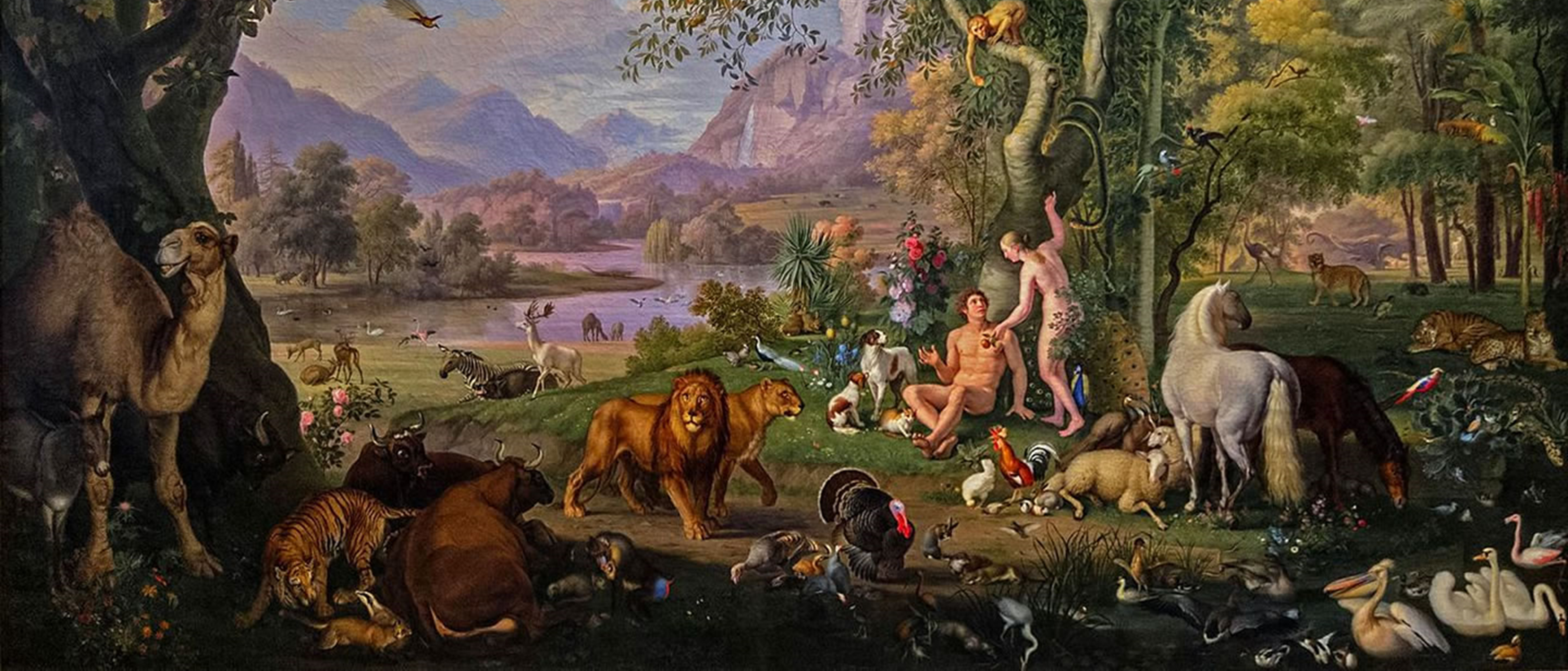
But there is more: A third foundational fact in the Christian development of science and technologies was that the early and medieval Christians understood that God intended they apply the gift of reason to understanding and ordering the gift of Creation—for our flourishing. They saw this important role of reason in the cultural mandate already in Genesis—for example, in the task assigned to Adam and Eve of naming the animals, or God’s charge to them to cultivate and keep the garden.
That the medieval church was not afraid to exercise this mandate of applying reason to the world is illustrated in the story of the man who became pope just before the turn of the millennium – in 999 AD. Of humble origins, Gerbert of Aurillac – who was perhaps relieved to be able take the papal name Sylvester – had developed through talent and education into Christendom’s foremost mathematician. A teacher of arithmetic, astronomy, and harmonics, Gerbert’s knowledge in these fields was admittedly hampered by his inability to read Greek—and therefore to read the best of the ancient pioneers of those fields. But his career showed that even in those so-called “dark ages,” the study of natural philosophy (what we have called “science” only since 1834) was no impediment to a highly successful career in the church. And why should it be? For early and medieval Christians adapted that field of study, “natural philosophy,” from the Greek philosophers, only now understanding it as the study of God’s wisdom as reflected in his creation.
In fact, a couple of hundred years after Gerbert, another Christian scholar, Hugh of St. Victor, described the natural world as a book written by God’s finger – and therefore just as appropriate for Christians to study as the Bible.
For medieval natural philosophy to develop into science as we know it today, however, it needed two more understandings.
2. Reason is a gift too, and an important part of God’s image in us
A second important fact for the historical Christian engagement in scientific and technological pursuits is that from the earliest years, Christians have understood human reason as a second gift, along with creation. This positive understanding of reason flourished, again, from the earliest years of the church. As historian Jaroslav Pelikan puts it, “When the Christian gospel came into the world, it succeeded in converting the most rational of men, the Greek philosophers, to its message; this was proof that the gospel was not to be dismissed as irrationality and ‘insanity.’”
Among those converted philosophers were such key early Christian leaders as Athenagoras of Athens, Justin Martyr, and Clement and Origen of Alexandria. Such thinkers continued to function as philosophical teachers, and in that role, they forged systematic Christian understandings of God, humanity, and the world – a tradition of Christian thought that has continued to today.
Now you may suspect that when I say this tradition of careful Christian thought about things “continued to today,” I’m passing too lightly over the medieval Church critiqued by Condorcet. Wasn’t that Enlightenment skeptic right? Weren’t medieval people ignorant haters of knowledge who were sitting around waiting for the Enlightenment to happen so they could finally crawl out of the darkness and into the clear light of reason? That is what we so often hear.
A reasonable place to start this “story in ten facts” might be with the scientific revolution—traditionally dated from the 1543 publication of Copernicus’s On the Revolutions of the Heavenly Spheres to the 1687 publication of Isaac Newton’s Principia. As soon as we look at this revolution – the seedbed of all modern scientific disciplines—we see some potential problems with the warfare thesis.
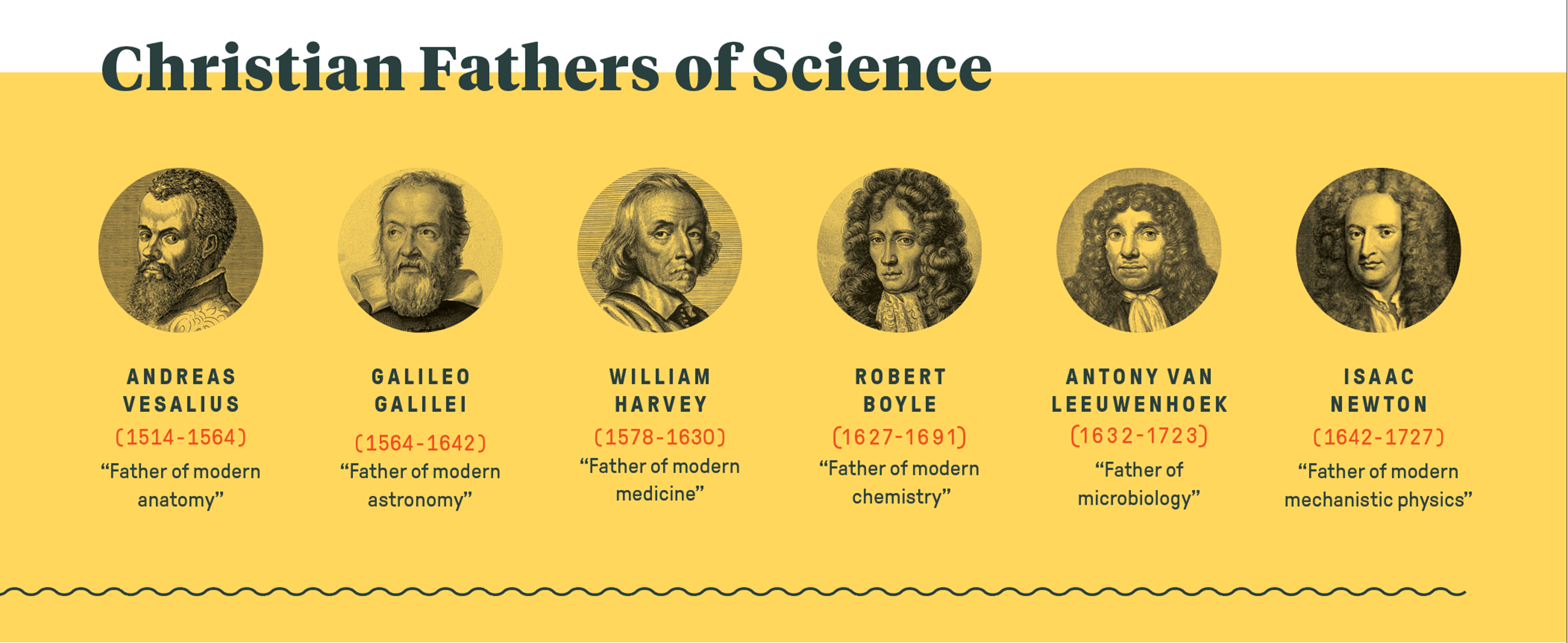
First, we notice that the scientific revolution happened before the secularizing Enlightenment—traditionally dated from the death of the French king Louis XIV in 1715 to the outbreak of the French Revolution in 1789. In other words, modern science was born in a Europe still thoroughly Christian in its thinking and institutions. That being true, it’s not surprising that almost all of the scientists who founded modern scientific disciplines during that period were themselves Christians [see illustration at the top of part I]. You’ll see a few named here – and we could include so many others, from Nicolaus Copernicus to Johannes Kepler to Blaise Pascal. Every one of these innovators was a person of faith who pursued scientific and technological innovation out of Christian motives and understandings.
I know what you’re thinking. “Ah, but what about Galileo? Wasn’t his work on the solar system suppressed by the church? Didn’t he become a prisoner to religious bigotry?” Well, no. It turns out Galileo ended up on trial before the Inquisition more because of his political naivete and lack of tact than anything else, and that the trial was more a legal dispute than a clash of beliefs. Says historian Thomas Mayer, “The notion that Galileo’s trial was a conflict between science and religion should be dead. Anyone who works seriously on Galileo doesn’t accept that interpretation any more.”
Illustration from C Armstrong, “The Pursuit of Science for God and Neighbor,” Common Good magazine issue #3, pp. 48-53
For many years I’ve attended – and sometimes spoken at – the Acton Institute’s annual four-day June meeting, “Acton University.” The 2022 meeting will happen June 20-23 both in-person in Grand Rapids and online. I’ll be giving a talk there titled “Christian foundations of science & technology innovation: A story in ten facts.” Here it is:
I’d like to start our reflection together with a question about finding Christian vocation in this tremendously important sector of modern work: science and technology.
Christians today are often told that we must bridge the so-called “sacred-secular divide” by finding divine purpose and mission in our daily work. And that sounds good in theory. It certainly has good support in both Scripture and tradition—from the Apostle Paul to Gregory the Great to Martin Luther and beyond. But where it often runs aground is in our actual experience.
Because, truthfully, our modern work contexts, and even the nature of the work we do in those contexts, seems to many of us—for many reasons—about as secular as can be.
So here’s the vocation question: How can we discover Christian vocation in fields of work that Luther could not have even imagined—let alone the Apostle Paul? In particular, how can modern people of faith experience work in the scientific laboratory or the high-tech firm as Christian mission?
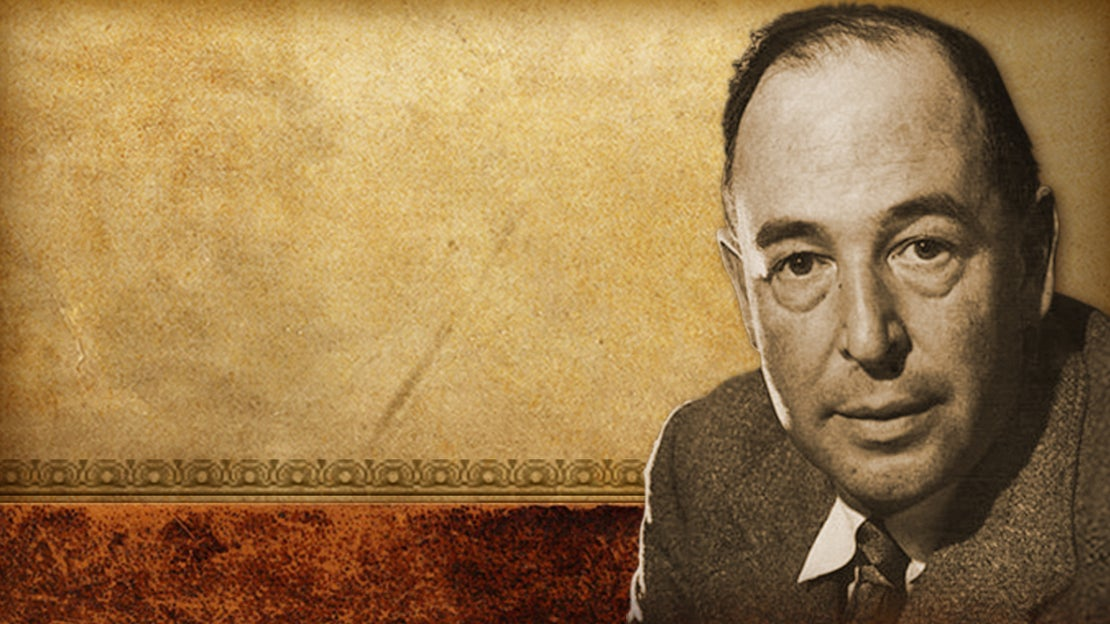
I find in C S Lewis a modern person who, throughout his life, lived and worked according to this medieval-inflected, sacramental, incarnational way of seeing and being. So it may be worth looking at a few ways he did that. We can start, again, with his imaginative writings. One is reminded, for example, of the wonderful image of a loving and materially comfortable domesticity in the beaver family portrayed in Lewis’ The Lion, The Witch, and the Wardrobe — which in turn was so like the similarly convivial, rustic life of his friend Tolkien’s hobbits in the Shire with their love of pipes and parties and meals together. Or his novel That Hideous Strength, which is from one end to the other a defense of the real holiness of ordinary virtues of embodied life — work, married sexuality, household life, and all — against the gnostic technocrats who would strip away all material mediations of sacred meanings and virtues in our ordinary lives.
In his letters, too, you can often find Lewis celebrating the sacred in the materiality of our ordinary life and work, even as he recommended to his correspondents that they read medieval writers for the good of their souls. He liked to sign his letters with that very embodied moniker Saint Francis of Assisi had used for himself: “Brother Ass.” And in one of those letters to a sick friend, he said of his own aging and increasingly malfunctioning body: “I have a kindly feeling for the old rattle-trap. Through it God showed me that whole side of His beauty which is embodied in colour, sound, smell and size.”
Dr. Grace Hamman invited me to join her on her podcast, Old Books with Grace, and we had an enjoyable and wide-ranging conversation–largely about Things Medieval and why they still matter today. Boethius, Anselm, Margery Kempe, and Christian humanism all made appearances, among other people and topics. Thank you, Grace! You can find her podcast on all major platforms; for convenience, here’s a link to this new episode on one of those.
The theological term for this vibrant medieval understanding of the material world, as Lewis well knew, is sacramentalism. This is a linked set of beliefs, first, that the outward and visible can convey the inward and spiritual; second, that all creation is in some sense a reflection of the creator; and third, that God is present in and through every square inch of his world. While these beliefs are linked with the more limited, liturgical sense of the word “sacrament,” they amount to an understanding of the whole material world.
The world-sacramentalism of medieval Christians was rooted in a lively engagement with the doctrine of Creation — through an even livelier engagement with the doctrine of the incarnation. The incarnation was the central preoccupation of medieval Christians. Art, theology, church life, and private devotion all focused on the incarnation. The Gospel accounts of Jesus’ bodily life and death became the medieval “canon within the canon”; the puzzle of why he had to come and die was the great theological obsession.
And in the midst of it all came the insight that, as Christ raised humanity by taking on humanity, he also in some mysterious sense, by taking on created form in his own creation, also raised up the whole world toward its new-creation destiny — such that even the rocks cry out and creation groans as it awaits that fulfilment.
In light of that cosmic redemption, and quite contrary to modern stereotypes of barbarism and otherworldliness, medieval Christians affirmed the material and social dimensions of our created human lives (our eating, drinking, working, marrying, getting sick, being healed, and eventually dying) as transcendentally important.
“My sister and her baby” Joy Coffman from San Diego, CA, US Creative Commons
A friend asked me to write a short comment for the new scholarly journal Faith & Flourishing on the question, “Why is the flourishing of the world an important subject for scholarly inquiry?” My response:
Christianity’s absorption and reinterpretation of the classical tradition, as described for example in the work of Robert Louis Wilken, included in every age—from Irenaeus to Augustine to Aquinas to the Reformers to the post-WW II resurgence described by Alan Jacobs in his Year of Our Lord: 1943—a strong commitment to flourishing. This was especially the flourishing of humans in all our dimensions (salvation = wholeness). The evergreen Christian humanism forged in that Christian-classical synthesis—which has amounted, as Jens Zimmermann has said, to a coherent Christian “philosophy of culture”—took different forms in every age but was never seriously challenged until the modern era.
By capitulating to the disenchantment of the world—and of humanity—that was insisted upon in the materialist biology of Darwin, the materialist psychology of Freud, and the materialist social teachings of Marx (among others), we have entered an age when a purely naturalistic “exclusive humanism”—one kind of “closed immanent frame”—to use two of Charles Taylor’s labels, has become convincing to many as a way of understanding humanity and human flourishing. And the church of the 20th and 21st century has no coherent answer. Having lost track of that older tradition of Christian humanism despite strong advocacy on its behalf by writers as diverse as C S Lewis, Jacques Maritain, Dietrich Bonhoeffer, and Pope John Paul II, we have spiritualized faith beyond all recognition, removing it from the ordinary workings of the world and society.
And now we are surprised when ordinary Americans (for instance) see the truth that this denatured faith has nothing to offer to our ordinary life in the world—and they are leaving the church in droves. We must retrieve our heritage: the long and strong tradition of pro-creation, pro-material, pro-embodiment, pro-social Christian humanism grounded in the claim that the incarnation has inaugurated a new humanity. We must again, to adapt Pierre Hadot’s phrase, practice “theology as a way of life”—not as a disembodied and detached technical pursuit.
The theology of the world operative within Christian humanism has been not just a theology of material creation or nature. It has also been a theology of the human, social world in which we live, and which Christian humanism navigated through the culture-creating development of such areas of our life together as ethics, law, and both political and economic theory and practice.
Scholastic humanism and the social world
For example, in parallel to the scholastic humanists’ pursuit of natural philosophy (as science was then called), and at first surpassing it in its power to bring order and peace to the world, was the study and systematization of law. Of course in that Christendom age, that law was religious, or “canon” law. This connection had deep historical roots – when in the 4th century the Benedictine monk Gratian had combined “the theoretical principles and legal procedures of the existing Roman law code with the content of ecclesial canon law,” he was providing “the first basic, universal textbook in response to the growing need for the legal administration of emerging Christendom” – and not surprisingly, it was the papal courts that became the ultimate recourse for most matters, fatefully cementing the church’s political as well as spiritual power.[1]
The scholars whose trust in human reason underwrote their approach to these social dimensions of flourishing (and science too could certainly be included as having a strong social dimension) grounded this trust not only in the doctrine of creation, but also – not surprisingly – in “the concept of the incarnation as God’s reconciliation with creation and his most intimate fellowship with humanity.” The resulting “medieval synthesis” “wove nature, humanity, reason and religion into a meaningful tapestry of ennobling purpose that was central to medieval theology from the twelfth century onward.”[2]
In sum, the three powerful legs of this great platform of scholastic humanism were “[the assurance of] God’s love, the intelligibility of creation and the trustworthiness of human reason.” And on this platform, medieval Christians built the foundational institutions of Western societies—the hospital, the university, a nascent scientific establishment, a growing artistic establishment, the superstructure of European law, and more.[3]
This blog contains over 720 posts as of Oct 2020 (also over 518,000 views from 210,000 unique visitors since inception in June 2010). If you read something you like, odds are there are at least one or two other posts dealing with similar topics. Which is why there’s a search box right below this message. :)
Francis of Assisi--part of an altarpiece by Bartolomeo Vivarini, in the Brooklyn Museum
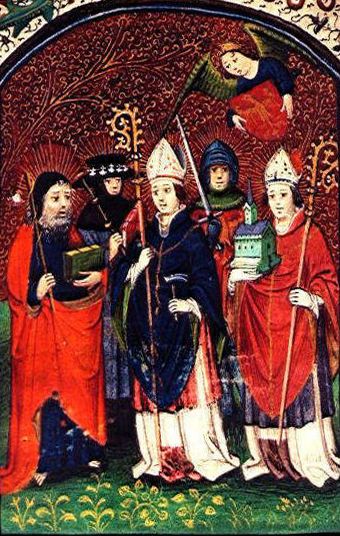
From a mid-15th-century Dutch prayerbook: Saint James the Great; Saint Joseph; Saint Ghislain, abbot of St Ghislain, near Mons; Saint Eligius; Saint Ermes (Hermes)
Gregory the Great and St. Mamertinus, from a 14th-century French translation of Jacobus de Voragine, Legenda aurea
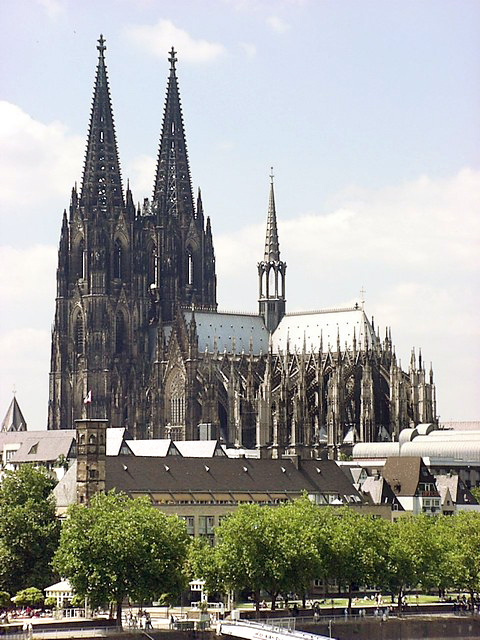
Cologne Cathedral
The clocktower of the Saint-Leu-Saint-Gilles church in Saint-Leu-la-Forêt (Val-d'Oise), France
Masaccio, Crucifixion, 1426 (Naples, Museo Nazionale di Capodimonte); the blonde figure is Mary Magdalen




 Medieval Wisdom for Modern Christians




 Grateful to the dead