Tag Archives: morality

How C S Lewis used story to initiate the reader into a traditional moral vision by awakening desire


Fairies RingThis rough clip is from the “Tradition” chapter of my forthcoming Getting Medieval with C. S. Lewis. The burden of the “Lewis introduction” of the chapter is that Lewis saw himself, vocationally, as a “traditioner” for a generation losing touch with its roots. This bit explores how Lewis sought to carry out that vocation (at least in part) through storytelling.

I believe, through Paul Ford’s Companion to Narnia, I’ve been led to the key to my chapter on tradition and Lewis’s relationship to tradition and our need for it. The key is how, through re-narrating the stories of our traditions, through narrative form, we are led to indwell truths of the past, Enjoying them (“looking along the beam” of sunlight, and seeing all things by it) and not just Contemplating them (“looking at the beam,” and seeing only the dust motes floating in it). This is what Lewis did in his stories, per Ford in his section on “Stories” in the introduction to his Companion.

It is as Lewis said: Reason is the organ of truth; imagination is the organ of meaning. Therefore if we are to pass the meaning of our faith from generation to generation, it must be done through story. Remarkably, Lewis succeeded in doing that, in even passing the meaning of faith to other generations—to the generation of children (like the kids he had staying with him during the Evacuation) by means of his stories. Stories do this—they allow us to indwell imaginatively a world of meaning, by showing us examples of it (of that meaning, ethics, spirituality) which train our affections, which give us new habituses in ways that mere doctrinal catechesis can never do. Continue reading

Education for the heart: A “Lewisian” reflection from former Christianity Today editor-in-chief David Neff


education heartOne of my favorite pedagogues these days is James K. A. Smith, professor of philosophy at Calvin College. In his series-in-progress entitled Cultural Liturgies, he argues that human beings are not primarily thinking animals but must be regarded instead as “desiring animals.” Head knowledge, especially head knowledge gained from an instructor who is “teaching to the test,” is aimed at the wrong part of the moral anatomy to make good citizens. We need a pedagogy that “aims below the head,” says Smith, in order to help students rightly order their loves and desires.

. . .

The kind of close reading advocated by Lewis meets what I believe is an innate desire for self-transcendence. “We want to see with other eyes, to imagine with other imaginations, to feel with other hearts, as well as with our own,” Lewis writes. He compares close reading with love, with moral action, and even with the fundamental act of learning. “In love we escape from our self into one another …. [E]very act of justice or charity involves putting ourselves in the other person’s place .”

Thanks, David Neff, for your reflection on education today. You (and C. S. Lewis and James K. A. Smith) hit the nail on the head.

Continue reading

The deepest values of early American evangelicals, revealed in what Methodists said about their dead; part III


Continued from “The deepest values of early American evangelicals, revealed in what Methodists said about their dead; part II

The highest virtues:  “the courage of one’s 

Peter Cartwright, Methodist circuit rider and "man's man"

convictions” and the boldness to speak them

Along with this manly work-ethic, Methodist memorialists of the 19th century seem most to admire the traits of unshakeable conviction and bold speech.  In fact, the phrase “the courage of his convictions” is liberally laid on throughout the 19th century.   As early as 1793, Benjamin Carter, an ex-soldier, was noted as “a pointed, zealous preacher, and a strict disciplinarian,” who “appeared not to fear the face of any.”  Ninety years later, in 1884, the eulogist of Tennessee’s Robertson Fagan wrote, “He was of ardent temperament, indomitable will, and commanding faith,” “not a man of half measures,” whose “power over men seemed to be almost magical.” Continue reading

The deepest values of early American evangelicals, revealed in what Methodists said about their dead; part II


Continued from “The deepest values of early American evangelicals, revealed in what Methodists said about their dead; part I“:

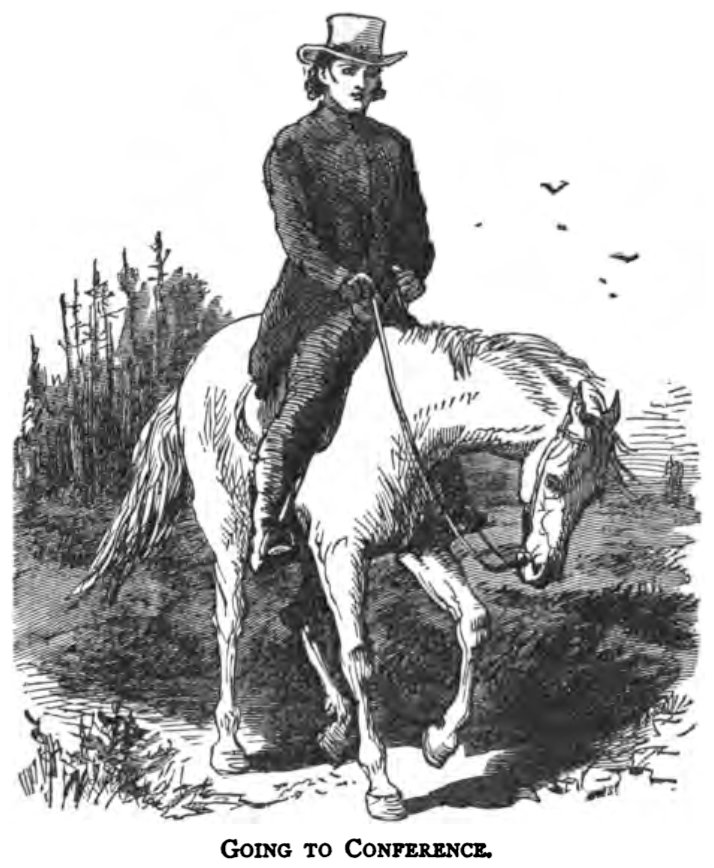
Illustration from Edward Eggleston, The Circuit Rider: A Tale of the Heroic Age (1906): A Methodist circuit rider on horseback

One purpose of these “memorials,” and certainly a primary purpose of the separate volumes of memorials which were reprinted, was to present to people everywhere, Christian and non-Christian, the “moral example” of these dedicated ministers of Christ.  This purpose perhaps ran deeper as the Victorian age wore on.

For example, at the front of the Black River and Northern New York Conference Memorial, Second Series, edited by Rev. P. Douglass Gorrie, and published in 1881, the editor presents the following wish:

The Author begs leave to present his feeble, yet grateful Tribute of Respect to the Memories of Departed Worth and Moral Heroism.

His subjects he goes on to describe as “the noble dead.”  In the preface of the same book, the only regret expressed in its publication is “that each and all had no more worthy pen to portray the virtues that adorned their Christian character.” (v-vi) Continue reading

C S Lewis and “medieval morality”


The following are some thoughts on how C S Lewis will figure as a “guide” into the look and feel of the “moral fabric of the Middle Ages,” and how that fabric differs from our own. It’s basically me grinding away at the grist for this Medieval Wisdom for Modern Protestants book.

My argument in this chapter is not that Christianity—either in the medieval period or any other period—has taught some distinctive morality, or even that it taught that morality in a distinctive way (although it did, from the earliest years of the church, as Robert Louis Wilken persuasively argues in The Spirit of Early Christian Thought). Rather, my argument is that today, Protestants, especially evangelicals, have fallen so in love with Luther’s (Augustine’s) message of grace, and have so spiritualized their faith (I almost said Gnosticized, and sometimes I wonder) that questions of morality have receded from view. So we need to hear again from a time (the Middle Ages) when Christianity structured not only people’s worship, but also their moral lives. Continue reading

Fundamentalism since the 1970s: An in-depth article


The following is a narrative and analysis of fundamentalism since the 1970s. I wrote it for Charles Lippy and Peter Williams’s Encyclopedia of Religion in America, just published last month.

The basic argument of what follows is this: Fundamentalism in America changed after the 1970s–perhaps so much that the word “fundamentalism” is no longer appropriate for what it became. In that decade, the movement began a tectonic shift from protecting theological truths in infra-denominational fights to guarding “Christian morality” in a nation specially chosen by God.

To be sure, “correct” views of the person of Christ and his atoning work, along with vividly detailed end-time scenarios, have continued to occupy an important place in the movement, but these things are not what the “new fundamentalists” are most centrally about. No, they have seen America locked in a battle with a secularizing juggernaut, and they have rushed to take up the “arms” of pragmatic political measures and boundary-breaking religious alliances in order to gain the upper hand.

From the year 1980 on, the majority of those who took upon themselves the mantle of historic fundamentalism have sought to shore up family values, sexual mores, and biblical views of creation rather than orthodox doctrines and denominational power. And although this may look like a completely new direction compared with the emphases of fundamentalism’s formative decades (the 1920s – 1950s), I argue that it is, rather, a natural development from the earlier movement’s characteristic concerns.

These are not your mom and dad’s fundamentalists.

This is their story:

FUNDAMENTALISM: CONTEMPORARY

Chris R. Armstrong

As the decade of the 1980s opened, friends could rejoice, and opponents warn, that in the words of the historian Martin Marty, fundamentalism was now “back with a vengeance.” This time, however, the opponent was not theological liberals within the denominations, but secularizing forces within the nation. Continue reading

The theology of Jack Bauer and 24


Here, according to Huffington Post writer John Shore, is the theology (or more accurately, anthropology) of 24‘s Jack Bauer.

I’ll admit, I read this with only very partial knowledge of the series. Lo, these many years ago, during the show’s first season, I became addicted within a couple of episodes. Then I realized it keyed me up way too much and took me way too often to my “dark place,” and I quit watching.

But I think Shore may be on to something in this piece. What do you guys think?