Tag Archives: Tradition

Debunking the Protestant “T” word: An edifying tale, part I


Icon depicting the First Council of Nicaea.

Icon of the First Council of Nicea

Once in a while I get to talk to a group of Protestants about one of our shibboleths, the “T word”–that is, tradition. And I make the case that tradition is not the sort of extra- and anti-biblical “rules of man” thing that they think it is. It’s not “stuff added to the Scripture to which the consciences of good Christians have been bound by an evil hierarchical church.”

In fact, tradition has been for 2,000 years the stuff of the faith of quite possibly the majority of world Christians. And it was the stuff of the faith of almost every Christian not just before the Reformation, but right through the Reformation, including the thought and commitments of Luther, Calvin, and other great Reformers. Calvin’s Institutes are full of footnotes to the church fathers. Why do that if Scripture is your only authority and is perfectly clear on all matters? Continue reading
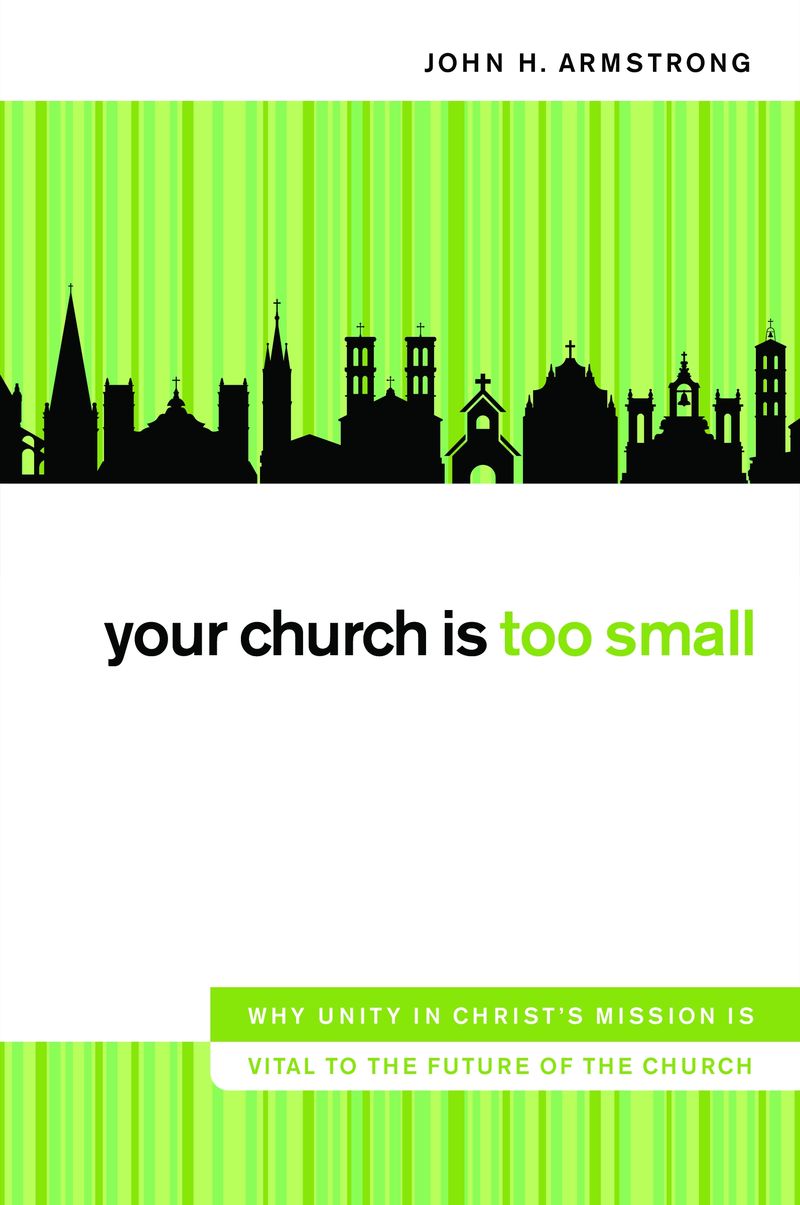
John H. Armstrong says Your Church Is Too Small—a blog review


I’ve been browsing the Deep Creek Anglican Church Blog‘s chapter-by-chapter review of John H. Armstrong’s new book, Your Church Is Too Small: Why Unity in Christ’s Mission Is Vital to the Future of the Church.

I was unfamiliar with John’s [no relation, as far as I know!] ministry until now. But having skimmed the review at the above blog, I think I find in him a kindred spirit. Sectarianism based on epistemological modernism is indeed a scourge of the church today. A balanced, critical ecumenism rooted in a heightened appreciation for tradition is indeed a much-needed balm. What I see here makes me want to know more about Armstrong’s ministry. Continue reading

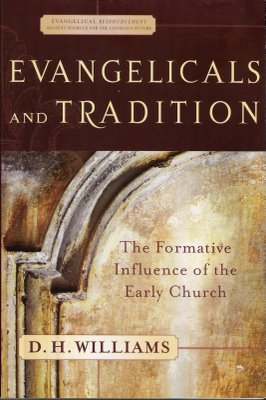
Evangelicals and Tradition: iMonk review


Since I have mentioned D. H. Williams’s book Evangelicals and Tradition several times on this blog, I figure it’s time to provide a bit more information. Here is a reflection and review of the book by the late “internet monk,” Michael Spencer:

My list of must-read books for post-evangelicals is short. Newly added at the top of the list: Evangelicals and Tradition: The Formative Influence of the Early Church (Evangelical Ressourcement: Ancient Sources for the Church’s Future) by Baylor University professor of patristics and Baptist minister D. H. Williams (Ph.d, University of Toronto.).

Reviews of D.H. Williams’ work on the need for evangelicals and free churchers to recover the catholic tradition are everywhere on the web. (By both Roman Catholics and by leading Evangelicals.) Continue reading

Is contemplative prayer a legitimate Christian practice?


Cover of

Over at Internet Monk, an excellent review of a book on classic Christian spirituality, Gary Thomas’s Sacred Pathways, has stirred up a heck of a hornet’s nest. A couple of critics are insisting at some length that contemplative prayer of the sort Thomas, Foster, Willard, and others recommend is “syncretistic” and thus dangerous.

Here is an excerpt from the review:

If you’ve read anything else by Gary Thomas or checked out his website, you know that unlike some evangelicals he believes that the Holy Spirit has been active throughout Christian history, not just since 1517. Continue reading

Chastened modernism or principled postmodernism–comments inspired by C S Lewis on medieval morality


It occurred to me that this comment and my response, spurred by the post “C S Lewis and ‘medieval morality'” may be worth its own post, as an invitation to others to join the conversation: Continue reading

Stanley Hauerwas on evangelical immediatism and the need for tradition


I have written here before on evangelical immediatism (the assumption that we meet God in an unmediated way) as a toxic solvent that destroys the good we could gain by submitting ourselves to various aspects of Christian tradition.

For all that Stanley Hauerwas annoys me on a number of fronts, he sums up this issue pithily in the course of an interview about his recent memoir Hannah’s Child, with Wunderkammer Magazine: Continue reading

Jaroslav Pelikan: Glimpses into medieval theology


These are brief excerpts and quotations I marked while reading Jaroslav Pelikan’s The Growth of Medieval Theology (600-1300), Vol. 3. in his series The Christian Tradition: A History of the Development of Doctrine (Chicago: The University of Chicago Press, 1978).

As with the David Bell “glimpses” posted yesterday, I thank my t.a., Shane Moe, who transcribed these and inserted  brief contextual tags where helpful. Page numbers are at the beginning of each excerpt. The designation “Q” means I wanted to save the text as a quotation, for use in teaching and writing. “D” means a definition of a term. “Use” means I want to use an idea or statement in my teaching:

Q, 3: “The Middle Ages may be seen as the period when the primary focus of Christian thought about Christ shifted from what he was to what he did, from the person of Christ to the work of Christ.” Continue reading

Does evangelical “immediatism,” or direct access to God in Jesus, mean we cannot learn from tradition? No.


One may say: well, if evangelical mysticism/immediatism (direct access to God in Jesus) has stunted our ecclesiology by making everything between the individual and God negotiable according to a sort of pragmatics of piety (see my previous post), then it must also militate against tradition in all senses of that term.

In other words, our tendency to emphasize direct experience of God must be the enemy of a full-orbed understanding and appropriation of the church fathers and other rich theological and spiritual sources from the shared Christian heritage. Yes?

But surprisingly, no. Or at least, not necessarily. And this suggests a program for evangelical renewal today, as I suggest in another section of my paper “Evangelicals and Tradition,” given at the 2007 meeting of the Evangelical-Roman Catholic Dialogue in St. Paul:

Lest we think that the Augustinian-Platonic focus on direct inward experience of the divine works only against tradition, however, we need only remember the Reformers’ own deep engagement in the thought of the church fathers. The Reformation was precisely the story of a group of people who saw unacceptable (they would have said, “modern”!) innovations in their church and worked to reform and renew it by reengaging with . . . yes, the Bible; yes, the New Testament church; but also and very significantly, the church fathers. When the late Robert Webber talked about the “ancient-future church,” he was saying only what the Reformers themselves were saying. Continue reading

Podcast on evangelical theology, globalization, postmodernism, and seminary education, with John Franke & friends


This conversation was really fun to have. And maybe even has some light to cast on, as my colleague Kyle Roberts says, “the present and future of evangelical theology, the challenge of globalization and postmodernity, the prospects for the evangelical church in the days ahead, and the role of seminary education in all of this.”

Kyle (a rising theologian, like Christian Collins Winn, who also speaks out on this podcast) explains: “The dialogue participants were John Franke, of Biblical Seminary (on campus to lecture at Bethel University and Seminary), Chris Armstrong, church history professor at Bethel Seminary, Christian Collins Winn, historical theology professor at Bethel College of Arts and Sciences, and myself. Enjoy this discussion and please add any comments or questions of your own for further discussion.  We view this as the beginning of a conversation, not the end.”

Enjoy the podcast, and (we hope) many fascinating posts to come on Kyle’s blog.

The monks did it: Mining medieval resources


My, how time flies. (In the words of the immortal Groucho Marx: “Time flies like an arrow. Fruit flies like a banana.” But then again, in the words of the immortal Douglas Adams: “Time is an illusion. Lunchtime, doubly so.”) Last May my Patron Saints for Postmoderns was not yet published, I was hoping against hope that my book proposal Medieval Wisdom for Modern Protestants [maybe Medieval Wisdom for Today’s Christians?] would be accepted by a publisher, and I was posting a blog entry over at Christianity Today’s history blog eagerly anticipating my first Medieval Congress at Western Michigan University in Kalamazoo.

Now Patron Saints has been out for many months, Medieval Wisdom is due to the publishers (Baker Books) next December, and the Medieval Congress at Kalamazoo is again just around the corner as May approaches. Here’s my CT blog post from last year anticipating my first Congress:

The Monks Did It

If we move beyond a piecemeal approach to medieval Christianity, we can mine the rich vein of its spiritual, intellectual, and practical resources.

by Chris Armstrong

Medieval_writing_desk.jpg

This weekend I am attending the 44th International Congress on Medieval Studies at Western Michigan University in Kalamazoo. This is the largest and most prestigious international gathering for medievalist scholars, convening over 3,000 scholars in over 600 sessions of papers, panel discussions, roundtables, workshops, and performances.

Frankly, though I am no medievalist, just thinking about being there is making me drool.

What’s an American church history geek doing attending a meeting that will feature hundreds of highly technical papers in a field I hardly know, based on texts in languages I’ve never learned – Latin, Old English, Old Norse? Continue reading